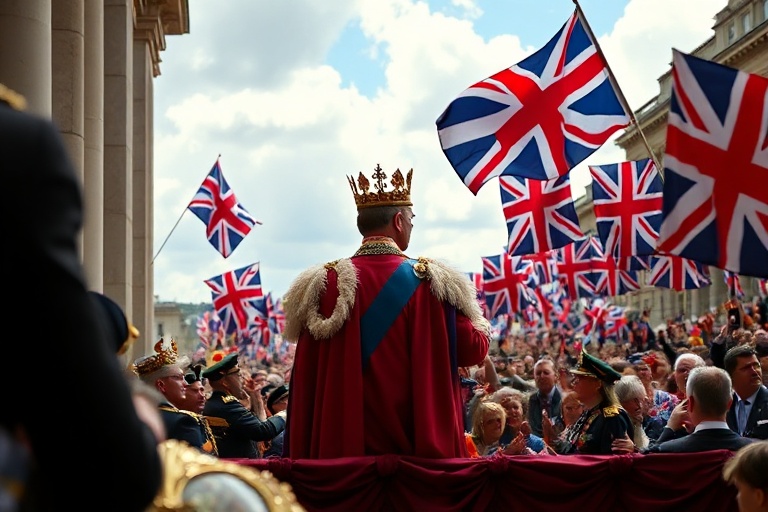
King Charles III: The British Monarchy’s Modern Transition
“`html
King Charles III: The British Monarchy’s Modern Transition
The ascension of King Charles III marked a pivotal moment not just for the British monarchy but for global perceptions of tradition and modernity. Succeeding Queen Elizabeth II in September 2022, Charles inherited a role steeped in centuries of history while facing unprecedented scrutiny in an era of rapid social change. His reign began under the shadow of his mother’s nearly 70-year tenure, yet it quickly became clear that his vision for the monarchy would diverge in subtle but significant ways.
Born in 1948, Charles Philip Arthur George was the eldest child of Elizabeth II and Prince Philip. His upbringing was meticulously planned by the royal establishment, designed to prepare him for a life of public service. This included rigorous education at Gordonstoun School—known for its austere discipline—and later at Trinity College, Cambridge, where he studied archaeology and anthropology. His formative years were also marked by personal struggles, including his challenging marriage to Diana Spencer, which ended in divorce in 1996. These experiences shaped his public persona as a figure caught between duty and personal conviction.
The Early Reign: Balancing Tradition and Reform
Charles III’s early months on the throne were defined by a delicate balancing act. While he pledged to uphold the traditions of the monarchy, he also signaled a willingness to adapt. One of his first acts was to shorten the name of the royal house from “House of Windsor” to “Windsor,” a nod to his desire for modernity without abandoning heritage. However, his reign has not been without controversy. His decision to move into Clarence House shortly after Elizabeth II’s death—rather than Buckingham Palace—was seen by some as a practical choice and by others as a symbolic break with the past.
Public opinion of Charles III has been a study in contrasts. Polls conducted by YouGov and other organizations have shown fluctuating support, with younger demographics often expressing skepticism about his relevance. Yet, his steadfast commitment to environmental causes—through his charity, the Prince’s Trust, and his long-standing advocacy for organic farming—has earned him admiration in certain circles. His speeches, often laden with philosophical musings, have drawn both praise for their eloquence and criticism for their perceived pomposity.
Global Symbolism: The Monarchy’s Role in the 21st Century
The monarchy under Charles III operates in a world where constitutional monarchies are increasingly rare outside Europe. His role extends beyond the United Kingdom, serving as a symbolic figurehead for 14 Commonwealth realms, including Canada, Australia, and Jamaica. However, the monarchy’s relevance in these nations is no longer taken for granted. In Jamaica, for example, there have been growing calls for republicanism, with some politicians arguing that the island nation should remove Charles as its head of state. This reflects a broader trend across former British colonies, where debates about colonial legacy and national identity have intensified.
Charles III’s visits abroad have often been met with a mix of curiosity and protest. During his 2022 tour of the Caribbean, he faced demonstrations in Belize and Jamaica, where activists demanded reparations for slavery and called for an end to the monarchy. These moments underscore the complex legacy of colonialism that the British Crown still embodies. Unlike his mother, who represented continuity, Charles is navigating a role that requires both acknowledgment of historical injustices and a forward-looking vision for the monarchy’s place in the world.
Key Moments in Charles III’s Early Reign
- September 8, 2022: Charles is proclaimed king following the death of Queen Elizabeth II, becoming the oldest British monarch to ascend the throne at 73.
- September 9, 2022: His coronation is announced for May 6, 2023, a date chosen to allow for a period of mourning while maintaining tradition.
- May 6, 2023: Charles III is crowned at Westminster Abbey in a ceremony that blends centuries-old rituals with modern elements, including a shorter procession and a focus on sustainability.
- 2023-2024: The king faces health challenges, including a diagnosis of cancer and subsequent treatment, which temporarily suspends some of his public duties.
- 2024: Charles delivers his first Christmas broadcast as monarch, emphasizing themes of hope and unity amid global conflicts.
Cultural Impact: The King as a Modern Icon
Charles III’s cultural footprint extends beyond politics and diplomacy. His lifelong passion for the arts—particularly his patronage of the Royal Shakespeare Company and his own watercolor paintings—has positioned him as a patron of British culture. His 2021 documentary, King Charles III: The Future Monarch, offered a rare glimpse into his personal philosophy, revealing a man deeply engaged with the arts, architecture, and environmentalism.
Yet, his cultural influence is not without controversy. His architectural tastes, often criticized as overly traditional, were on full display in 2023 when he unveiled plans for a new wing at the National Gallery. Similarly, his environmental advocacy, while laudable, has been scrutinized for its practicality. His organic farming initiatives, for instance, have been praised for their innovation but also dismissed by critics as performative rather than substantive.
In popular culture, Charles III has been both celebrated and lampooned. The Netflix series The Crown portrayed him as a complex figure, torn between ambition and duty, a narrative that has shaped public perception. Meanwhile, satirical programs like Spitting Image have exaggerated his mannerisms, reducing him to a caricature of the “overeducated royal” stereotype. These portrayals highlight the challenge Charles faces in crafting an image that resonates with diverse audiences.
The Future of the Monarchy Under Charles III
As Charles III enters the latter half of his reign, the monarchy’s future remains uncertain. The challenges are manifold: declining public support in the Commonwealth, the financial burden of maintaining the royal family, and the need to modernize while preserving tradition. His son, Prince William, has already begun taking on more high-profile duties, suggesting a potential shift in the monarchy’s structure. However, Charles’s personal legacy will be defined by how he navigates these transitions.
One area where Charles has shown adaptability is in his approach to social media. Unlike his predecessors, he has embraced digital platforms, using them to share messages directly with the public and engage with younger audiences. His Instagram account, launched in 2019, has amassed millions of followers, offering a glimpse into his official duties and personal interests. This digital presence is a calculated move to humanize the monarchy and bridge the generational gap.
The monarchy’s survival in the 21st century may well depend on its ability to evolve. Charles III’s reign offers a case study in how tradition and modernity can coexist—albeit uneasily. His greatest challenge may not be in maintaining the status quo but in redefining what the monarchy means in an era where symbols of inherited power are increasingly questioned.
Conclusion
King Charles III’s reign is a study in contrasts: a monarch rooted in tradition yet navigating the demands of a rapidly changing world. His early years on the throne have been marked by both continuity and disruption, reflecting the broader tensions within the British establishment and the Commonwealth. As he continues to shape his legacy, the monarchy’s future hangs in the balance. Will Charles III be remembered as a transitional figure, a reformer, or a guardian of an institution struggling to survive? The answer may lie not in the grandeur of his coronation but in his ability to listen, adapt, and redefine the role of a king in the modern age.