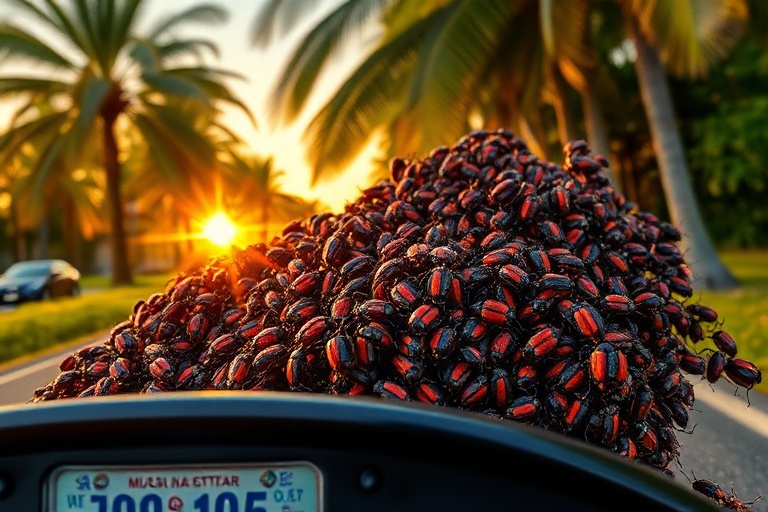
Twice a year, Florida transforms into a surreal landscape of black-and-red insects drifting lazily in the air. These are the infamous love bugs (Plecia nearctica), a species so peculiar that they’ve become a defining quirk of the Sunshine State. While locals have learned to navigate the sticky aftermath on car grills, visitors often react with a mix of fascination and horror. The phenomenon isn’t just a Florida oddity—it’s a biological marvel with global implications.
Love bugs are native to the Gulf Coast region, thriving in the humid subtropical climate where warm temperatures and abundant rainfall create ideal breeding conditions. Their brief adult lives—just a few days to a week—are spent almost entirely in copulation. The name itself is a nod to their most distinctive behavior: they mate mid-flight, often in long, uninterrupted chains that resemble a living, buzzing rope. This spectacle, while comical to some, serves a critical ecological purpose.
The Science Behind Love Bugs
Love bugs are Diptera, belonging to the same order as mosquitoes and houseflies, but their lifecycle is far more specialized. They begin as larvae in moist soil, feeding on decaying organic matter before pupating into adults. What makes them unique is their synchronized emergence, which occurs in May and September, timed to coincide with Florida’s rainy seasons.
Entomologists note that love bugs play a role in nutrient cycling. Their decomposing bodies enrich the soil, and their larvae help break down leaf litter. Yet their sudden appearance can overwhelm ecosystems. During peak swarms, schools of fish have been observed gorging on the fallen insects, while birds like swallows and nighthawks adjust their feeding patterns to capitalize on the bonanza.
Globally, synchronized insect emergences aren’t uncommon. Cicadas in the eastern U.S. famously appear in 13- or 17-year cycles, and some moth species in Africa and Asia exhibit similar boom-and-bust population dynamics. However, love bugs stand out for their sheer density—estimates suggest billions emerge during each flight period in Florida alone. This scale makes them a case study in how climate and human activity influence insect populations.
Why Do They Swarm in Such High Numbers?
Several factors contribute to the love bug phenomenon’s intensity:
- Climate synchronization: Love bugs rely on precise environmental cues—temperature, humidity, and daylight—to trigger emergence. Florida’s predictable weather patterns ensure large, coordinated hatches.
- Agricultural expansion: The conversion of wildlands into farmland (particularly cattle pastures) has created vast expanses of grassy habitats rich in decaying organic material, perfect for larval development.
- Lack of natural predators: While birds and spiders do prey on love bugs, their sheer numbers overwhelm local predators, allowing populations to explode unchecked.
- Invasive species dynamics: Some researchers speculate that Florida’s love bug population may have benefited from the state’s history of importing non-native plants, inadvertently creating more breeding grounds.
Cultural Impact: From Folklore to Frustration
Love bugs have woven themselves into Florida’s cultural fabric. Locals treat them with a mix of resignation and dark humor. Road signs near Gainesville warn motorists of “love bug season,” and businesses sell everything from high-pressure car washes to “love bug repellent” sprays. The insects have also inspired art, music, and even a minor tourism industry—some visitors travel to Florida specifically to witness the swarms, documenting the surreal experience on social media.
Internationally, Florida’s love bugs have become a symbol of the state’s untamed natural beauty. Comparisons are often drawn to Japan’s matsuri festival insects, like the fireflies of Toyama or the cicadas of Nagano, which are celebrated for their beauty rather than tolerated as a nuisance. Yet love bugs lack the poetic associations of these species. Instead, they’re framed as a practical challenge—proof that nature, when left unchecked, can assert itself in inconvenient ways.
In 2022, a viral video of a Florida highway blanketed in love bugs sparked debates about urban planning. Should cities invest in infrastructure to mitigate the insects’ impact, or is the occasional car wash a small price to pay for Florida’s ecological balance? The conversation reflects a broader tension between human convenience and environmental stewardship, a debate playing out in ecosystems worldwide.
Global Lessons from Florida’s Love Bugs
Florida’s love bugs offer a microcosm of challenges facing regions grappling with invasive species and climate change. As temperatures rise and rainfall patterns shift, scientists predict that love bug populations may expand northward into Georgia and Alabama. Meanwhile, other parts of the world are experiencing similar insect booms—from the mosquito plagues of Southeast Asia to the locust swarms devastating crops in East Africa.
These events underscore the delicate balance of ecosystems. Love bugs, for all their nuisance, are a reminder that every species—no matter how unglamorous—has a role to play. Their synchronized life cycles also highlight the vulnerability of species that rely on specific environmental conditions. As Florida’s climate becomes more erratic, even the humble love bug may face existential threats.
For now, though, they remain a defining feature of the state. Residents have learned to time road trips around their flight periods, and tourists snap photos of the bizarre spectacle. Love bugs are more than just a quirk; they’re a testament to nature’s unpredictability—and humanity’s ongoing struggle to coexist with it.
How to Coexist with Love Bugs
If you’re visiting or living in Florida during love bug season, a few precautions can make the experience more tolerable:
- Avoid driving during peak swarm hours (10 a.m. to 3 p.m.): While love bugs aren’t aggressive, they can reduce visibility and create slippery road conditions.
- Park your car in a garage or under cover: Their acidic bodies can damage paint if left uncleaned for more than a day.
- Wear light-colored clothing outdoors: Love bugs are attracted to dark colors, which may increase their presence around you.
- Use a fine-mesh screen on windows:
- Embrace the absurdity: Many Floridians treat love bug season as a rite of passage—part of the state’s unique charm.
This simple measure can keep them out of your home without blocking airflow.
Love bugs may not be everyone’s idea of a charismatic species, but they’re a fascinating example of nature’s adaptability. As Florida continues to grow and change, these insects will remain a fixture—albeit an occasionally frustrating one. Perhaps that’s the lesson: even the most unassuming creatures can leave an indelible mark on a place’s identity.