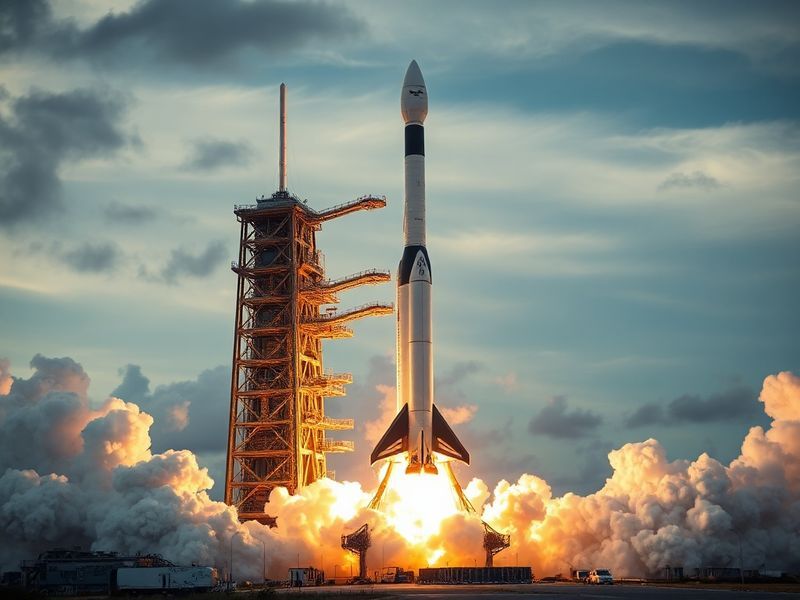
SpaceX Falcon Heavy: The Rocket Changing Heavy-Lift Spaceflight
“`html
SpaceX Falcon Heavy: The Rocket Redefining Heavy-Lift Spaceflight
SpaceX’s Falcon Heavy stands as a testament to modern aerospace innovation, pushing the boundaries of what commercial spaceflight can achieve. Since its maiden launch in February 2018, the rocket has consistently demonstrated its capability to deliver massive payloads into orbit while maintaining cost efficiency. Unlike its predecessors, Falcon Heavy leverages reusable technology to reduce expenses, making space more accessible for both government and private missions.
The rocket’s design builds upon SpaceX’s proven Falcon 9 architecture, essentially tripling its lifting power by clustering three first-stage boosters. This approach has allowed SpaceX to secure contracts for complex missions, including the launch of the James Webb Space Telescope and multiple national security payloads. Its versatility extends to commercial satellite deployments and even interplanetary missions, cementing its role as a cornerstone of 21st-century space exploration.
The Engineering Behind Falcon Heavy’s Power
At the heart of Falcon Heavy’s performance lies its three-core first stage, each equipped with nine Merlin engines. This configuration generates over 5 million pounds of thrust at liftoff, making it one of the most powerful operational rockets in the world. The center core is structurally reinforced to withstand the immense forces exerted during ascent, while the side boosters—modified Falcon 9 first stages—provide additional stability and power.
Recovery and reuse are central to SpaceX’s philosophy, and Falcon Heavy embodies this principle. After stage separation, the two side boosters perform synchronized landing burns, returning to Cape Canaveral or SpaceX’s drone ship for refurbishment. The center core, however, faces greater challenges due to the higher velocities required for payload delivery. In some missions, it is expended, while in others, it successfully lands for reuse. This flexibility allows SpaceX to optimize each launch based on mission requirements.
Payload Capacity and Mission Versatility
Falcon Heavy’s payload capacity varies depending on the mission profile. In its fully reusable configuration, it can deliver up to 63,800 kg (140,700 lbs) to low Earth orbit (LEO). For geostationary transfer orbit (GTO) missions, this drops to 26,700 kg (58,900 lbs), while interplanetary missions can carry up to 16,800 kg (37,000 lbs) to Mars. This wide range of capabilities makes it suitable for a diverse array of missions, from deploying constellations of satellites to sending probes to distant planets.
Notable missions include the 2019 Arabsat-6A launch, which marked the rocket’s first commercial flight, and the 2022 USSF-44 mission for the U.S. Space Force. The latter demonstrated Falcon Heavy’s ability to deliver payloads directly into geostationary orbit, a capability previously limited to larger or more expensive rockets. These successes have attracted interest from both government agencies and private enterprises, including NASA, which has considered Falcon Heavy for crewed lunar missions under the Artemis program.
Economic Impact and Cost Efficiency
One of Falcon Heavy’s most significant contributions to spaceflight is its cost-effectiveness. At approximately $90 million per launch, it undercuts many of its competitors while offering superior payload capacity. This price point is made possible by SpaceX’s reusable rocket technology, which drastically reduces the need for new hardware with each mission. Traditional expendable rockets, by contrast, require an entirely new vehicle for each launch, driving costs into the hundreds of millions.
The economic ripple effects of Falcon Heavy extend beyond launch costs. By lowering the financial barrier to space, it has enabled new industries to emerge, from satellite internet constellations like Starlink to commercial lunar landers. This democratization of access to space has also spurred competition, prompting other aerospace companies to develop their own heavy-lift vehicles to remain viable.
A Comparison with Other Heavy-Lift Rockets
Falcon Heavy is often compared to NASA’s Space Launch System (SLS), which is designed for crewed deep-space missions. While SLS boasts greater raw power—capable of lifting 95,000 kg (209,000 lbs) to LEO—its fully expendable design results in a per-launch cost exceeding $1 billion. This stark difference highlights the trade-offs between performance and affordability in modern rocketry.
Other competitors include Blue Origin’s New Glenn, which is still in development, and United Launch Alliance’s Delta IV Heavy, which is being phased out due to high costs. Falcon Heavy’s combination of power, reusability, and affordability positions it as a leading choice for heavy-lift missions in the coming decade. Its track record of successful launches further solidifies its reputation as a reliable workhorse for both government and commercial clients.
Challenges and Criticisms
Despite its achievements, Falcon Heavy has faced its share of challenges. The rocket’s development was marked by delays, with its inaugural flight pushed back several years from initial projections. Additionally, its infrequent launch cadence—averaging just one or two flights per year—has led some critics to question its long-term viability as a commercial vehicle.
Environmental concerns have also been raised about the rocket’s methane-fueled Merlin engines. While methane is cleaner than traditional hypergolic fuels, its production and combustion still contribute to carbon emissions. SpaceX has addressed these concerns by exploring greener alternatives, though no immediate replacements are in sight.
Another criticism revolves around the rocket’s role in the broader space industry. Some argue that while Falcon Heavy is impressive, it may not be the ultimate solution for all heavy-lift needs. For example, missions requiring the highest payload capacities or crewed deep-space flights may still rely on more specialized vehicles like SLS or Starship, once operational.
The Future of Falcon Heavy
Looking ahead, Falcon Heavy is poised to play a critical role in several high-profile missions. NASA’s Artemis program, which aims to return humans to the Moon, has identified Falcon Heavy as a potential launch vehicle for components of the Lunar Gateway, a planned space station in lunar orbit. This collaboration could further cement the rocket’s place in the future of space exploration.
SpaceX’s next-generation Starship, currently under development, is expected to eventually supersede Falcon Heavy for many missions. However, until Starship is fully operational and proven reliable, Falcon Heavy will remain a key asset for both government and commercial launches. Its proven track record and cost advantages ensure it will continue to be a workhorse for the foreseeable future.
The rocket’s legacy may also extend beyond Earth. Elon Musk has suggested that Falcon Heavy could play a role in early Mars missions, serving as a stepping stone toward larger, more ambitious interplanetary ventures. While Starship is the long-term focus for Mars colonization, Falcon Heavy’s capabilities could provide a bridge until more advanced systems are ready.
What’s Next for SpaceX?
As SpaceX continues to refine its technologies, the company is likely to focus on increasing the cadence of Falcon Heavy launches. Expanding its commercial customer base and securing more government contracts will be critical to maintaining its dominance in the heavy-lift market. Additionally, SpaceX is exploring upgrades to the rocket, such as enhanced second-stage engines, to improve performance and payload flexibility.
The success of Falcon Heavy also underscores the importance of competition in driving innovation. As other companies like Blue Origin and Rocket Lab develop their own heavy-lift vehicles, the space industry is entering a new era of collaboration and rivalry. This dynamic will ultimately benefit customers, as advancements in technology and reductions in cost make space more accessible than ever before.
For now, Falcon Heavy remains a symbol of what can be achieved through ingenuity, persistence, and a willingness to challenge the status quo. Its contributions to spaceflight are already significant, and its future missions promise to further expand the horizons of human exploration.
As we look to the stars, Falcon Heavy serves as a reminder that the journey to the cosmos is not just about raw power or cutting-edge technology. It’s about reimagining what’s possible and making the impossible a reality.