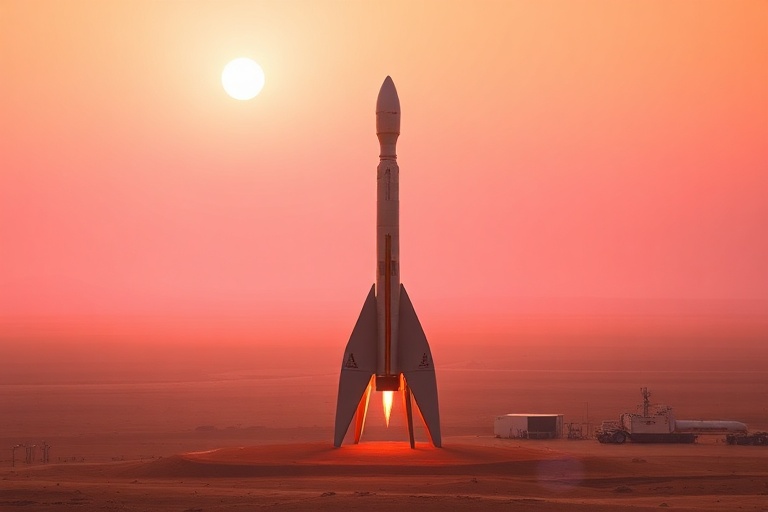
Starship: SpaceX’s Revolutionary Rocket for Mars and Beyond
“`html
Starship: The Rocket Redefining Space Exploration
The concept of Starship has shifted from science fiction to reality over the past decade. SpaceX, under Elon Musk’s leadership, has poured resources into developing a fully reusable spacecraft capable of carrying humans and cargo to Mars and beyond. This project isn’t just about building a rocket—it’s about reimagining humanity’s relationship with space.
What sets Starship apart is its scale and ambition. Unlike traditional rockets, which are discarded after a single use, Starship is designed to be entirely reusable. This approach aims to slash the cost of space travel, making missions to the Moon, Mars, and even interplanetary travel more feasible. The latest prototypes, such as SN20 and the orbital test vehicle, have pushed the boundaries of engineering, testing new materials, propulsion systems, and re-entry technologies.
Design and Technical Specifications
The Starship system consists of two main components: the Starship spacecraft and the Super Heavy booster. Together, they form the tallest and most powerful rocket ever built, standing at nearly 400 feet tall. The Super Heavy booster, equipped with 33 Raptor engines, provides the initial thrust needed to escape Earth’s gravity. The Starship spacecraft, powered by six Raptor engines, takes over for in-space maneuvers and landings.
Key features of the Starship design include:
- Full Reusability: Both the Starship and Super Heavy are designed to land back on Earth (or other celestial bodies) for refurbishment and reuse, drastically reducing launch costs.
- Stainless Steel Construction: Unlike traditional rockets that use lightweight composites or aluminum, Starship uses a stainless steel alloy. This material is cheaper, easier to work with, and performs better under extreme temperatures.
- Rapid Refurbishment: SpaceX aims to turn around a Starship for relaunch within hours, a goal that would revolutionize space logistics if achieved.
- Payload Capacity: Starship can carry up to 100 metric tons to Earth orbit, with future iterations expected to increase this capacity significantly.
The Raptor Engine: A Leap in Propulsion Technology
The Raptor engine is the heart of the Starship system. Unlike the Merlin engines used in SpaceX’s Falcon rockets, the Raptor uses a full-flow staged combustion cycle, which improves efficiency and thrust. Each Raptor engine burns a mix of liquid methane and liquid oxygen (methalox), a fuel choice that offers several advantages. Methane is easier to produce on Mars, making it a practical fuel source for return trips from the Red Planet.
Early tests of the Raptor engines have demonstrated impressive performance, with thrust levels exceeding 230 tons per engine. However, reliability remains a challenge. During early prototype tests, several engines failed during static fires or flight attempts, leading to explosions. These setbacks are part of the iterative development process, but they highlight the technical hurdles SpaceX must overcome before Starship can enter regular service.
Milestones and Challenges in Development
SpaceX’s journey with Starship has been marked by rapid iteration and occasional setbacks. The company’s approach—building, testing, and learning in quick cycles—has accelerated progress but also led to high-profile failures. Let’s break down some of the key milestones and challenges:
- 2019-2020: Early Prototype Tests
The first Starship prototypes, known as Starhopper and the Mk1 series, were built at SpaceX’s facility in Boca Chica, Texas. These early models were primarily used to test basic flight dynamics and landing procedures. The Starhopper, a stripped-down version, successfully completed a 150-meter hop in August 2019, demonstrating the viability of the Raptor engine in a flight environment.
- 2021: High-Altitude Flight Tests
The SN8 through SN15 prototypes took flight in late 2020 and early 2021, reaching higher altitudes and attempting controlled landings. While most of these tests ended in dramatic explosions during the landing phase, they provided critical data on aerodynamics, engine performance, and control systems. The SN10 prototype achieved a soft landing in March 2021 but exploded minutes later due to a methane leak.
- 2022-2023: Orbital Test Attempts
The most ambitious test to date was the first orbital flight attempt in April 2023, involving the fully stacked Starship and Super Heavy. The rocket lifted off successfully but encountered a problem during stage separation, leading to a controlled detonation. Despite the failure, the test provided valuable insights into the vehicle’s performance and highlighted areas for improvement.
- Regulatory and Environmental Hurdles
Starship’s development hasn’t been purely technical. SpaceX has faced scrutiny from regulatory agencies, particularly the Federal Aviation Administration (FAA), over environmental concerns. The Boca Chica facility, now renamed Starbase, is located in a sensitive ecosystem, and the FAA’s environmental assessment delayed testing for months. SpaceX has had to implement measures to mitigate environmental impact, including reducing noise pollution and protecting local wildlife.
Starship’s Role in Space Exploration and Beyond
Starship isn’t just another rocket—it’s a cornerstone of SpaceX’s long-term vision. NASA has already selected Starship as the lunar lander for its Artemis program, which aims to return humans to the Moon by 2026. The contract, worth nearly $3 billion, positions Starship as a critical component of NASA’s plans for sustainable lunar exploration.
Beyond the Moon, Starship is central to Musk’s goal of establishing a self-sustaining city on Mars. The company envisions a fleet of Starships making regular trips to the Red Planet, carrying supplies, infrastructure, and eventually, the first human settlers. To achieve this, SpaceX is working on in-situ resource utilization (ISRU) technologies, which would allow astronauts to produce fuel from Martian resources like water and carbon dioxide.
Starship also has implications for commercial spaceflight. Companies like SpaceX’s Starlink division could benefit from cheaper, more frequent launches, enabling faster deployment of satellite networks. Additionally, Starship’s capacity to carry large payloads could revolutionize deep-space science missions, allowing for more ambitious telescopes, probes, and even crewed missions to asteroids or the outer planets.
Economic and Industry Impact
The Starship program is expected to disrupt the space industry in several ways. First, its full reusability could reduce the cost of launching payloads to orbit from roughly $1,500 per kilogram (with the Falcon 9) to as low as $100 per kilogram. This price drop could unlock new markets, including space tourism, manufacturing, and even space-based solar power.
Second, Starship’s development has spurred competition. Other companies, such as Blue Origin with its New Glenn rocket and Relativity Space with its Terran R, are racing to develop heavy-lift reusable rockets. This competition could accelerate innovation and further drive down costs across the industry.
However, the economic viability of Starship remains unproven. SpaceX has invested billions of dollars into the program, and it’s unclear when the company will achieve a profitable return. The high-risk, high-reward nature of the project mirrors the early days of aviation or the internet, where pioneers gambled on technologies that later transformed society.
What’s Next for Starship?
SpaceX has outlined an aggressive timeline for Starship’s development. The company aims to conduct another orbital test flight in 2024, with subsequent tests focusing on improving reliability and performance. Key goals for the near future include:
- Achieving a successful orbital flight with intact stage separation and landing.
- Demonstrating rapid reuse by relaunching a prototype within weeks of its first flight.
- Completing the development of the Lunar Starship, tailored for NASA’s Artemis missions.
- Beginning cargo missions to Mars, with the first crewed mission potentially launching in the late 2020s.
The challenges ahead are substantial, but the potential rewards are transformative. If Starship succeeds, it could usher in a new era of space exploration, where humanity becomes a multi-planetary species. For now, the world watches as SpaceX continues to push the boundaries of what’s possible.
As Elon Musk has stated, the ultimate goal of Starship is to make life multi-planetary. Whether the rocket achieves this vision remains to be seen, but its impact on the space industry is already undeniable. Starship isn’t just a rocket—it’s a symbol of human ambition, innovation, and the relentless pursuit of the impossible.