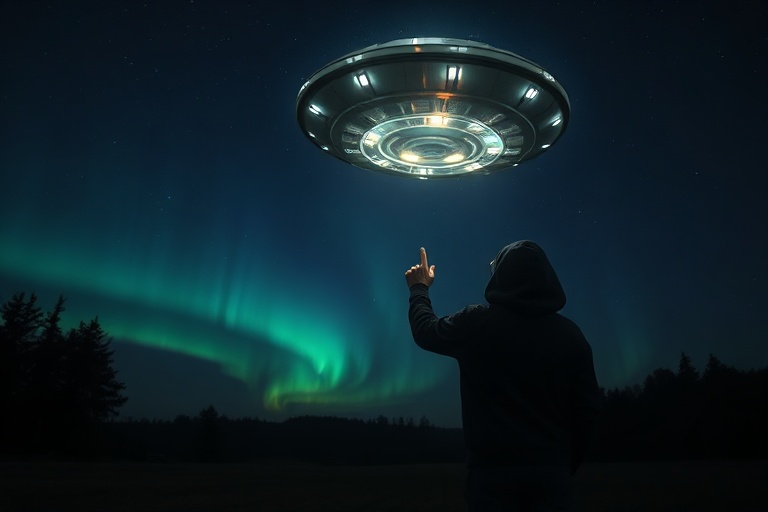
UFO Sightings: A Global Look at the Unexplained Mysteries
“`html
UFO Sightings: A Global Look at the Unexplained
Reports of unidentified flying objects have fascinated humanity for decades. What began as sporadic accounts in the mid-20th century has evolved into a worldwide phenomenon, with thousands of sightings documented annually. Whether dismissed as natural phenomena or embraced as evidence of extraterrestrial life, these encounters continue to spark debate across cultures and continents.
The modern fascination with UFOs can be traced back to 1947, when pilot Kenneth Arnold reported seeing nine crescent-shaped objects flying near Mount Rainier in Washington State. Though he described their movement as “like a saucer skipping across water,” the media quickly popularized the term “flying saucer.” This incident marked the beginning of a cultural obsession that would span generations, influencing everything from government investigations to Hollywood blockbusters.
The Science Behind the Sightings
While many UFO encounters defy immediate explanation, science offers several theories to account for what witnesses observe. Atmospheric conditions, such as temperature inversions or lens flares, can create optical illusions that trick the human eye. Similarly, drones, aircraft, or even celestial bodies like Venus or Jupiter have been mistaken for unidentified objects. Yet some cases remain stubbornly resistant to conventional analysis.
In 2021, the U.S. government released a preliminary report on UFOs, now officially termed Unidentified Aerial Phenomena (UAP). The document acknowledged 144 reports from military personnel over a 17-year period, with 18 of those encounters displaying “unusual flight characteristics.” While the report stopped short of confirming extraterrestrial origins, it opened the door to serious scientific inquiry. Researchers at Harvard’s Galileo Project, led by astrophysicist Avi Loeb, have since advocated for a systematic approach to studying these phenomena using advanced sensors and AI.
Not all scientific explanations are mundane. Some researchers propose that certain UAPs could represent breakthroughs in physics, such as advanced propulsion systems or even wormholes. Others suggest the possibility of inter-dimensional travel, where objects from other planes of existence briefly manifest in our reality. While these theories remain speculative, they underscore the need for open-minded investigation rather than automatic dismissal.
A Global Tapestry of Encounters
UFO sightings are not confined to any single region. Each culture interprets these phenomena through its own lens, often blending ancient mythology with modern technology. In Mexico, the 1970s saw a surge in reports, particularly in the state of San Luis Potosí, where witnesses described metallic discs with humanoid figures. These accounts were later linked to a string of cattle mutilations, fueling speculation about extraterrestrial experimentation.
Across the Atlantic, Europe has its own rich history of UFO encounters. In 1989, a wave of sightings swept through Belgium, where thousands reported seeing triangular craft with bright lights. The Belgian Air Force scrambled fighter jets, but the objects—capable of hovering motionless or accelerating at impossible speeds—eluded capture. The case remains one of the most compelling in European ufology, often cited as evidence against conventional explanations.
Asia offers a different perspective. In Japan, UFO sightings are frequently tied to folklore, with some locals interpreting them as tengu, mythical creatures from traditional tales. Meanwhile, China’s state-run media has occasionally reported on military radar tracking unidentified objects, though official commentary remains cautious. The diversity of global interpretations highlights how UFOs serve as a cultural mirror, reflecting societal fears, hopes, and curiosities.
Notable Encounters Around the World
- Roswell Incident (USA, 1947) – The most famous UFO case, where a rancher discovered debris initially claimed to be from a “flying disc.” The military later attributed it to a weather balloon, though conspiracy theories persist.
- The Voronezh Incident (Russia, 1989) – A 16-year-old boy and other witnesses reported a landed UFO with three-eyed aliens. The case was investigated by local authorities, adding an official layer to the account.
- Colares UFO Flap (Brazil, 1977) – Residents of Colares reported small, red-orange objects that emitted beams of light, allegedly causing physical harm. The Brazilian Air Force launched Operation Prato to investigate.
- Trans-en-Provence Case (France, 1981) – A farmer captured physical evidence—burn marks and soil samples—after witnessing a craft land in his field. The case is often cited in scientific discussions due to its documentation.
Governments and the UFO Narrative
Governments have played a paradoxical role in the UFO discourse—simultaneously dismissing reports while secretly investigating them. The U.S. is perhaps the most transparent in recent years, with the Pentagon’s 2021 UAP report and subsequent congressional hearings. Other nations, however, remain tight-lipped. France’s GEIPAN office is one of the few government agencies to openly document and investigate UFO cases, boasting a database of over 3,000 reports. In contrast, Russia and China rarely acknowledge such sightings, though rumors persist of military files kept under lock and key.
The shift in tone from governments may reflect a growing acknowledgment that some UAPs cannot be easily explained. In 2023, NASA convened a panel of scientists to study UAPs, emphasizing the need for rigorous data collection. “We want to shift the conversation from sensationalism to science,” said NASA administrator Bill Nelson. This approach aligns with a broader trend: the mainstreaming of UFO research, which has moved from the fringes of conspiracy theory to legitimate academic inquiry.
Yet skepticism persists. Critics argue that government disclosures are merely attempts to manage public perception or, worse, misdirection. The declassification of UFO files often reveals mundane explanations, from weather balloons to foreign surveillance drones. But for believers, these admissions only scratch the surface of a much larger mystery.
Why Do UFOs Captivate Us?
At its core, the UFO phenomenon taps into deep human desires—to know we are not alone, to uncover hidden truths, and to imagine possibilities beyond our current understanding. This fascination is not merely about aliens; it’s about the unknown and our place in the universe. In an age of instant information, where algorithms promise to explain everything, UFOs represent a tantalizing crack in the façade of certainty.
Psychologically, UFO sightings often coincide with periods of societal anxiety. The Cold War era saw a spike in reports, as did the early 2000s, following the 9/11 attacks. Some researchers suggest that UFOs serve as a psychological outlet—a way to externalize fears about technology, government secrecy, or environmental collapse. Others point to the “giggle factor,” where the absurdity of UFO lore makes it an easy target for mockery, thereby shielding more serious discussions from scrutiny.
Culturally, UFOs have seeped into every corner of entertainment, from sci-fi films like Close Encounters of the Third Kind to documentaries exploring government cover-ups. They’ve inspired music, fashion, and even religious movements, such as the Raëlian Church, which claims humanity was created by extraterrestrials. This ubiquity ensures that UFOs remain a perennial topic of conversation, whether in serious debates or late-night internet rabbit holes.
The Future of UFO Research
As technology advances, so too does the potential to study UFOs more rigorously. Projects like the Galileo Project are developing AI-driven telescopes to scan the skies for anomalous objects. Meanwhile, the U.S. Defense Department’s All-domain Anomaly Resolution Office (AARO) continues to investigate military encounters, promising more transparency in the coming years.
Yet challenges remain. The stigma associated with UFO research has historically deterred scientists from pursuing it seriously. Funding is scarce, and many researchers risk professional ridicule. However, as more credible institutions—NASA, Harvard, and even the Vatican—begin to engage with the topic, the field may finally shed its fringe reputation.
For now, UFOs remain in the realm of the unexplained. But whether they are evidence of alien visitation, misunderstood natural phenomena, or something even more extraordinary, their allure shows no signs of fading. As long as humans gaze at the stars and wonder, the mystery will endure.
The next time you look up at the night sky, ask yourself: What’s really out there? And are we ready for the answer?