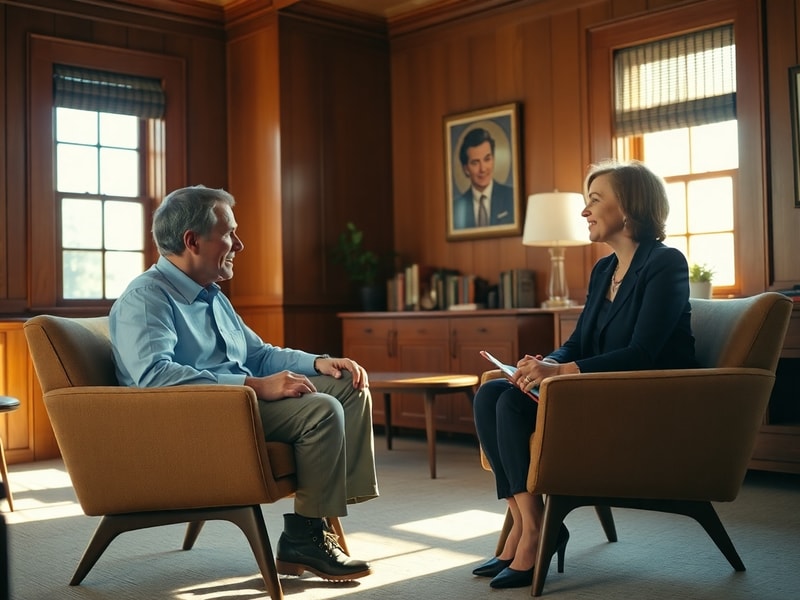
The Behind-the-Scenes Dynamics of Nick Bilton and Lesley Stahl’s Meeting
In the quiet corridors of media power, where influence is often measured in decibels and column inches, a meeting between two titans of journalism can reveal as much about the industry’s shifting tectonics as it does about the individuals involved. Nick Bilton, the former tech columnist for The New York Times and a sharp observer of Silicon Valley’s excesses, once shared a stage—or at least a conversation—with Lesley Stahl, the veteran correspondent of 60 Minutes, whose interviews have shaped public perception for decades. Their meeting, though not widely publicized, offers a window into how traditional media navigates the digital age, where the lines between reporter and subject, critic and creator, are increasingly blurred.
Their encounter wasn’t a formal interview but a professional exchange, one that underscored the tension between old guard journalism and the new wave of media critics who dissect technology’s impact on society. Bilton, known for his critical takes on companies like Uber and Twitter, brought a perspective that challenged Silicon Valley’s self-congratulatory narrative. Stahl, meanwhile, represented the institutional voice of 60 Minutes, a program that has long prided itself on holding power to account—even as its own relevance has been questioned in an era of viral journalism.
The Contrasting Worlds of Bilton and Stahl
Their backgrounds couldn’t have been more different. Bilton, a British expat who made his name in Silicon Valley, built a reputation as a contrarian. His 2013 book, Hatching Twitter, was a takedown of the social media platform’s toxic culture, earning him both praise and backlash. His writing for The New York Times and later Vanity Fair often read like a mix of investigative reporting and cultural commentary, blending data-driven analysis with sharp wit. Bilton’s work appealed to a younger, digitally native audience that distrusted traditional media’s sometimes stodgy approach.
Stahl, on the other hand, is a product of a different era. Her career spans five decades, during which she interviewed everyone from Fidel Castro to Mark Zuckerberg. Her interviews are meticulously crafted, often relying on the power of silence and the weight of her reputation to extract confessions or admissions. Stahl’s style is rooted in the belief that journalism should be a slow, deliberate process—one that prioritizes depth over speed. This approach has made her a symbol of the kind of reporting that thrives in an age of 24-hour news cycles and clickbait headlines.
Their meeting, then, was less about a clash of egos and more about the collision of two journalistic philosophies. Bilton’s willingness to challenge tech elites head-on contrasted with Stahl’s more measured, diplomatic approach. Yet both shared a fundamental belief in the power of journalism to shape public discourse—a belief that is increasingly tested in an era where information is abundant but trust is scarce.
Why Their Exchange Matters in a Fragmented Media Landscape
The media ecosystem today is a sprawling, fragmented landscape where legacy institutions like 60 Minutes coexist with digital-native outlets like Recode (where Bilton once worked) and viral platforms like Substack. Their meeting highlights a critical tension: How can traditional media adapt without losing its soul? Stahl’s presence in the room represented the weight of institutional authority, a reminder that journalism isn’t just about chasing clicks or chasing virality. It’s about asking the right questions, even when the answers are uncomfortable.
For Bilton, whose career has been defined by his willingness to ask those uncomfortable questions, the meeting may have been an opportunity to bridge the gap between the old and the new. His reporting on Silicon Valley’s excesses has often been dismissed by tech executives as anti-innovation, but it also sparked necessary conversations about ethics, privacy, and the unintended consequences of technological progress. Stahl, meanwhile, has seen her fair share of criticism for being too soft on power—whether it’s in her interviews with politicians or tech CEOs. Their exchange could have been a moment of mutual learning: Stahl gaining insight into the digital world’s complexities, and Bilton finding validation for his belief that traditional media still has a role to play in holding power accountable.
This dynamic is particularly relevant today, as social media platforms and algorithm-driven news outlets reshape how the public consumes information. A study by the News Media Alliance found that trust in mainstream media has declined by 12% over the past decade, while trust in social media as a news source has risen by 8%. In this environment, the kind of journalism practiced by Stahl and Bilton—whether in long-form interviews or investigative reporting—serves as a counterbalance to the noise. Their meeting, then, wasn’t just a footnote in their careers. It was a microcosm of the broader struggle to define journalism’s role in the 21st century.
The Unseen Influence of Their Conversation
While their meeting may not have been recorded or transcribed, its significance lies in what it represents: a quiet acknowledgment that the future of journalism isn’t a zero-sum game. It’s not about old media versus new media, or about print versus digital. It’s about finding common ground in a shared mission to inform the public, even when the methods and mediums differ.
For Bilton, whose career has been marked by his willingness to challenge the status quo, the meeting with Stahl could have been a reminder that tradition and innovation aren’t mutually exclusive. His work has often been celebrated for its fresh perspective, but it’s also been criticized for lacking the gravitas of legacy journalism. Stahl, on the other hand, represents the kind of gravitas that Bilton’s work sometimes lacks. Her interviews are legendary not just for their content, but for their craftsmanship—the way she lets a subject’s words hang in the air, the way she uses silence as a tool. Bilton’s reporting, by contrast, is often more conversational, more immediate. It’s designed to resonate with a younger audience that doesn’t have the patience for the slow burn of a 60 Minutes feature.
Yet both approaches are necessary in today’s media landscape. The public needs the kind of deep, investigative reporting that Stahl embodies, but it also needs the kind of sharp, timely analysis that Bilton provides. Their meeting, then, was a reminder that journalism isn’t a monolith. It’s a mosaic of voices, styles, and approaches, each contributing to the larger project of holding power to account.
Conclusion: A Lesson in Journalistic Evolution
The meeting between Nick Bilton and Lesley Stahl may never be recounted in a memoir or dissected in a think piece, but its importance shouldn’t be underestimated. In an era where media is often reduced to soundbites and viral moments, their exchange was a quiet affirmation of the enduring value of journalistic diversity. It was a reminder that the future of media isn’t about choosing sides—it’s about finding ways to coexist, to learn from one another, and to adapt without losing sight of the core mission: to inform, to challenge, and to hold power accountable.
For young journalists entering the field, their meeting offers a lesson in humility and adaptability. It’s a reminder that the best journalism isn’t defined by the platform or the medium, but by the commitment to truth and the willingness to ask the hard questions—even when the answers are uncomfortable. And for those who have spent decades in the industry, like Stahl, it’s a reminder that innovation isn’t the enemy of tradition. It’s an opportunity to evolve.
In the end, the meeting between Bilton and Stahl was more than just a professional exchange. It was a microcosm of the media’s ongoing evolution—a testament to the fact that even in an era of fragmentation and disruption, the core principles of journalism remain as vital as ever.