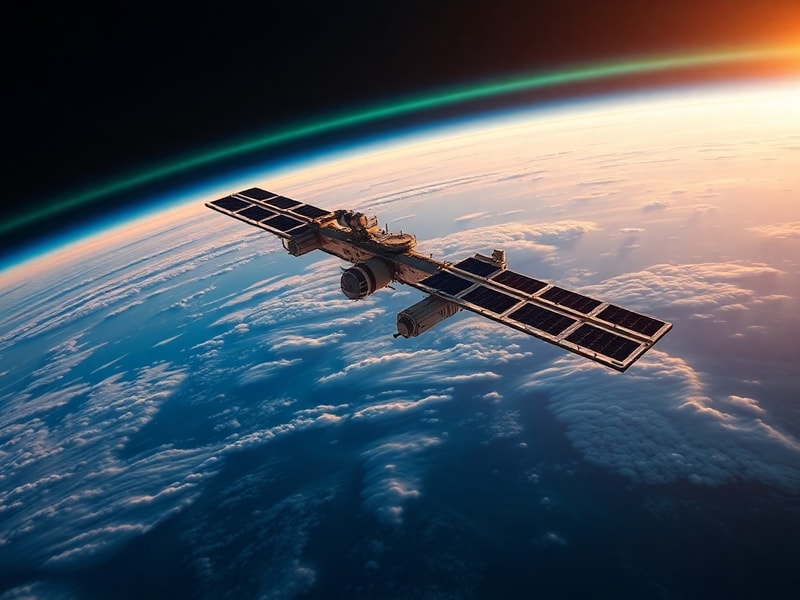
space station
“`html
Orbiting Homes: The Global Impact of Space Stations
The International Space Station (ISS) has been humanity’s most ambitious off-world project since its first module launched in 1998. It’s more than a laboratory; it’s a symbol of international cooperation, scientific discovery, and the enduring human desire to explore beyond Earth’s atmosphere. Over 25 years, the ISS has hosted astronauts from 20 different nations, proving that even geopolitical tensions on Earth can be set aside in the name of science.
But the ISS is only the beginning. As nations and private companies set their sights on the Moon, Mars, and beyond, space stations are evolving from singular achievements into a network of orbital habitats. These structures are redefining what it means to live and work in space, while also reflecting broader cultural and technological shifts on Earth.
The Birth of an Idea: From Cold War Rivalry to International Collaboration
The concept of a space station has roots in Cold War competition. The Soviet Union launched the first space station, Salyut 1, in 1971. The United States followed with Skylab in 1973. These early outposts were modest by today’s standards—small, temporary habitats designed for short-term missions. Yet they laid the foundation for something far greater.
By the 1980s, as tensions eased, space agencies began envisioning a permanent, international station. The fall of the Soviet Union accelerated this shift. In 1993, NASA and Russia’s Roscosmos signed an agreement to merge their separate plans into one: the International Space Station. Canada, Japan, and the European Space Agency soon joined, turning rivalry into collaboration.
The ISS wasn’t just a technical marvel; it was a diplomatic one. As nations contributed modules, robotic arms, and research, they also shared risks, costs, and discoveries. Today, the station remains a rare example of sustained global partnership in an era of rising nationalism.
Life Aboard the ISS: A Glimpse into the Future of Human Spaceflight
Life on the ISS is a carefully choreographed routine. Astronauts follow a strict schedule of work, exercise, and sleep to maintain health in microgravity. Every aspect of daily life—eating, sleeping, even using the toilet—requires specialized equipment and training.
Culturally, the ISS has become a melting pot. Crew members bring their national cuisines, traditions, and even personal items. The station’s galley includes Russian, American, Japanese, and European food, creating a kind of orbital fusion cuisine. Celebrations of holidays like Christmas, Nowruz, and Diwali have been observed in orbit, offering a poignant reminder of Earth’s diversity.
Communication with Earth is instant but carries a delay of less than a second. Astronauts use email, video calls, and even social media to stay connected. Many share stunning images of Earth, inspiring millions with views of sunrises over continents and auroras dancing over the poles.
Yet, life in space is not without challenges. Isolation, confinement, and distance from family can take a psychological toll. NASA and international partners have invested heavily in mental health support, including virtual reality relaxation sessions and regular psychological counseling.
The New Era: Commercial Stations and Lunar Gateways
The ISS won’t last forever. NASA plans to transition to commercially owned and operated space stations by the end of the decade. Companies like Axiom Space, Blue Origin, and Voyager Space are already developing modules that will eventually detach from the ISS to form independent outposts.
These commercial stations aim to serve a broader range of clients—not just government astronauts, but researchers, tourists, and even filmmakers. Axiom Space, for instance, has announced plans to send private crews to the ISS and eventually launch its own station. This shift reflects a growing belief that space should be accessible, not just to nations, but to people.
Beyond low Earth orbit, NASA’s Lunar Gateway—a small space station orbiting the Moon—is under development in partnership with international agencies. Scheduled for launch in the late 2020s, the Gateway will serve as a staging point for lunar landings and a testbed for deep-space technologies. It represents the next logical step: moving humanity’s presence from Earth’s backyard to the solar system at large.
A Cultural Mirror: How Space Stations Reflect Earth’s Hopes and Fears
Space stations are more than technological achievements. They are cultural artifacts that reflect the values, aspirations, and anxieties of their time.
During the 1970s and 1980s, space stations symbolized scientific progress and national pride. Today, they embody globalism and sustainability. The ISS’s solar panels, water recycling systems, and waste management technologies are often cited as models for circular economies on Earth.
Yet, they also highlight inequalities. Access to space remains unequal. While astronauts from dozens of countries have visited the ISS, many nations—especially in the Global South—have limited or no representation. This disparity fuels debates about who gets to shape humanity’s future among the stars.
Moreover, space stations have inspired art, literature, and film. From Stanley Kubrick’s 2001: A Space Odyssey to Andy Weir’s The Martian, they serve as backdrops for stories about human ingenuity, isolation, and survival. These narratives shape public imagination, reinforcing the idea that space is not just a frontier, but a shared destiny.
Looking Ahead: The Next Chapter in Orbital Living
The future of space stations is bright and diverse. Here’s what’s on the horizon:
- Private Stations: Companies are racing to build the first commercial space hotels and research platforms. These could host tourists, film crews, and even manufacturing facilities.
- Lunar and Martian Outposts: As humans return to the Moon and aim for Mars, orbital stations will serve as waypoints. These could evolve into permanent bases or even cities.
- International Expansion: China’s Tiangong space station, completed in 2022, is a major step forward. With plans to expand it and invite international participation, it could become a rival to the ISS.
- Sustainability Focus: Future stations will prioritize closed-loop life support, renewable energy, and zero-waste systems to ensure long-term viability.
Space stations are no longer science fiction. They are real, evolving, and increasingly accessible. They challenge us to think beyond borders, to collaborate across cultures, and to consider what it means to be human in the vastness of space.
As we look to the Moon, Mars, and beyond, these orbiting homes remind us that the final frontier isn’t just a place to visit—it’s a place to live, learn, and thrive together.
—
METADATA
{
“title”: “Space Stations: How Orbiting Labs Are Shaping Humanity’s Future”,
“metaDescription”: “From the ISS to commercial outposts, space stations are redefining exploration and global cooperation in the 21st century.”,
“categories”: [“Science”, “Technology”],
“tags”: [“International Space Station”, “commercial space stations”, “space exploration”, “orbital habitats”, “NASA”],
“imageDescription”: “A high-resolution photograph of the International Space Station orbiting Earth, showing its solar panels extended and multiple modules connected. The planet below displays swirling clouds and blue oceans, with a warm, sunlit glow highlighting the station’s metallic structure against the blackness of space.”
}
—END METADATA—
“`