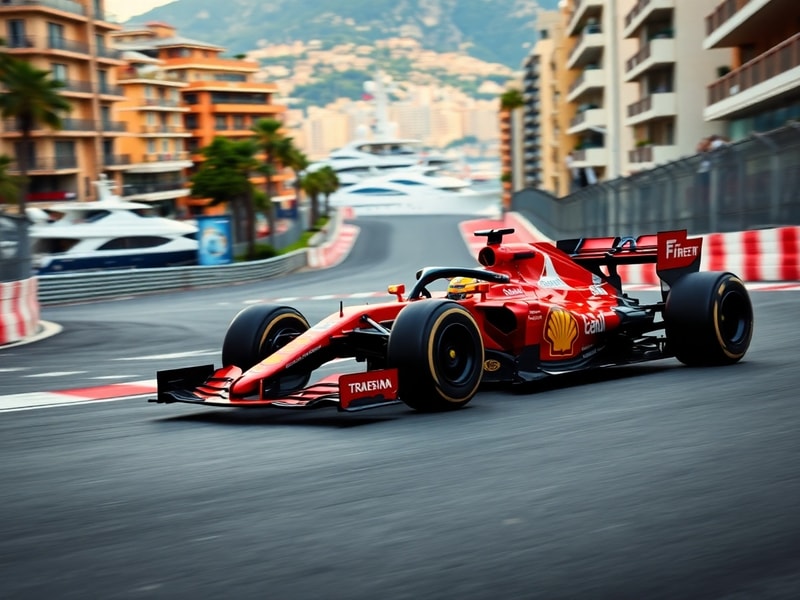
Monaco Grand Prix: The Ultimate Guide to F1’s Most Iconic Race
“`html
The Monaco Grand Prix: A Race Unlike Any Other
The Monaco Grand Prix stands as the crown jewel of the Formula 1 calendar, a race that blends elite motorsport with unparalleled glamour. Held annually on the streets of Monte Carlo, this event transforms the principality into a high-speed playground where precision, nerve, and luck collide. Unlike any other circuit in the world, Monaco’s narrow, winding layout demands more from drivers than raw speed—it tests their ability to dance on the edge of disaster while threading through barriers just inches from the car’s flanks.
The race’s origins trace back to 1929, when Antony Noghès, son of the president of the Automobile Club de Monaco, proposed the idea of a road race through the principality. With the backing of Prince Louis II, the first Monaco Grand Prix took place on April 14, 1929, featuring just 16 cars and a modest crowd. By the time Formula 1 adopted the event in 1950, it had already established itself as a symbol of prestige, attracting both drivers and spectators who craved its unique blend of danger and elegance.
The Circuit: A Masterpiece of Contradiction
The Circuit de Monaco is a paradox—a street circuit that punishes mistakes yet rewards the brave. At 3.337 kilometers long, it is the shortest track on the F1 calendar, but its complexity makes it one of the most challenging. Drivers navigate a series of tight corners, including the famous Casino corner and the tunnel section, where visibility drops dramatically. Elevation changes and blind crests add to the unpredictability, ensuring that even the most seasoned competitors must remain hyper-focused.
Overtaking is notoriously difficult on this circuit, making qualifying sessions absolutely critical. The pole position often translates into a race victory, as the narrow streets leave little room for maneuvering. Pit stops are a gamble; a single mistake in the pit lane can cost a driver dearly, while a perfectly executed stop can catapult them up the field. The Monaco Grand Prix is less about raw power and more about mastery of technique—a reminder that in Formula 1, skill often outweighs horsepower.
Legendary Moments and Unforgettable Victories
Over the decades, the Monaco Grand Prix has produced some of the most iconic moments in motorsport history. Ayrton Senna’s 1984 performance in the rain remains a masterclass in wet-weather driving, as he carved his way through the field in a Toleman car that was outmatched in dry conditions. His eventual disqualification denied him a podium, but the race cemented his reputation as one of the greatest drivers of all time.
In 1996, Olivier Panis claimed an improbable victory in changeable conditions, scoring his only F1 win in a race that saw just three cars cross the finish line. More recently, Max Verstappen’s 2021 triumph demonstrated the relentless pressure of Monaco, where even a small error can derail a championship campaign. The race has also been a stage for tragedy, most notably in 1967 when Lorenzo Bandini suffered fatal injuries after crashing into the harbor.
The list of winners reads like a who’s who of Formula 1: Graham Hill earned the nickname “Mr. Monaco” for his five victories, while Alain Prost and Michael Schumacher also found success on these treacherous streets. Each generation of drivers brings new stories to the race’s legacy, ensuring that Monaco remains a rite of passage for champions.
The Glamour and the Grit: Beyond the Racing
The Monaco Grand Prix is as much about the spectacle off the track as it is on. The yacht-lined harbor, the champagne-soaked after-parties, and the presence of royalty and celebrities elevate the event to a global social phenomenon. The paddock is a who’s who of the rich and famous, where fashion and speed collide in a dazzling display of opulence.
Yet beneath the glamour lies a race that is brutally unforgiving. The tight confines of the circuit mean that even a minor mistake can end a driver’s weekend in seconds. The barriers are unforgiving, the runoff areas minimal, and the pressure relentless. For the teams, Monaco is a logistical nightmare—transporting equipment through the principality’s narrow streets and setting up in temporary garages that feel more like a high-stakes puzzle than a race weekend.
The contrast between the luxury and the danger is part of what makes Monaco so compelling. While other races focus solely on the competition, Monaco offers a full sensory experience: the roar of the engines echoing off the buildings, the scent of saltwater from the harbor mingling with the aroma of fine dining, and the electric atmosphere of a crowd that has gathered to witness something truly unique.
Why Monaco Matters in the Modern Era
In an era where Formula 1 is increasingly focused on spectacle and entertainment, the Monaco Grand Prix remains a bastion of tradition. While other circuits embrace radical changes to improve racing, Monaco’s layout has remained largely unchanged for decades. This stubborn adherence to its heritage is both a strength and a point of contention, as purists argue for its preservation while critics call for modifications to enhance competition.
The race’s exclusivity also adds to its mystique. Unlike other events that prioritize accessibility, Monaco is a race that must be earned—whether through sponsorship, invitations, or sheer prestige. The hospitality suites overlooking the harbor, the private jets parked at Nice Airport, and the VIP guests in the stands all contribute to an atmosphere that is unmatched in sports.
For drivers, winning in Monaco is the ultimate validation. It is a race where talent is measured not just in lap times but in composure under pressure. The ability to conquer Monaco often separates the good from the great, as the circuit’s unique challenges expose weaknesses that other tracks do not. In a sport where margins are razor-thin, Monaco serves as a reminder that true greatness is forged in the crucible of adversity.
A Race That Defines a Sport
The Monaco Grand Prix is more than just a race; it is a cultural institution. It has outlasted generations of drivers, teams, and even the sport itself, evolving while remaining rooted in its traditions. In an era of constant change, Monaco offers a rare sense of continuity—a link to the past that keeps the heart of Formula 1 beating strong.
For fans, it is a pilgrimage. For drivers, it is a crucible. For the sport, it is a reminder of what makes Formula 1 so special. Whether you are drawn by the racing, the glamour, or the sheer drama of the event, one thing is certain: the Monaco Grand Prix is a race that will continue to captivate and inspire for generations to come.
To explore more about the history of Formula 1 circuits, visit our Automotive category. For insights into the evolution of motorsport technology, check out our Technology section.