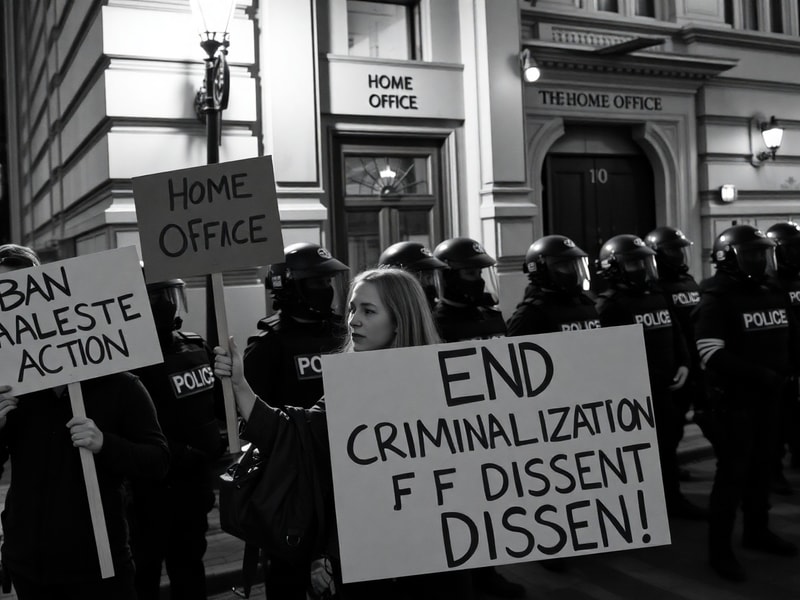
The recent ban on Palestine Action in the United Kingdom has ignited discussions far beyond its borders. While the group’s tactics have long been controversial, the government’s decision to classify it as an “extremist organization” marks a significant escalation. This move not only restricts the group’s activities but also raises broader questions about the boundaries of protest, freedom of expression, and the role of state intervention in civil society.
The ban follows years of targeted campaigns against arms companies linked to Israel’s military operations. Palestine Action has gained attention for its confrontational approach, including occupations of factories and symbolic acts of defiance. Critics argue that such tactics undermine legitimate dissent, while supporters view them as necessary resistance against perceived injustices. The debate now extends globally, as activists and legal experts weigh the implications of this decision.
The Origins of Palestine Action and Its Methods
Founded in 2020, Palestine Action emerged as a direct-action movement focused on disrupting the operations of companies supplying weapons to Israel. The group’s approach includes sit-ins, building occupations, and property damage—all designed to draw attention to what they describe as complicity in human rights abuses. While some view these actions as courageous civil disobedience, others condemn them as illegal or counterproductive.
The group’s most high-profile targets have included Elbit Systems, a major Israeli defense contractor with facilities in the UK. Palestine Action argues that such companies profit from conflicts that violate international law. Their campaigns often involve weeks-long standoffs with police, generating media coverage but also legal consequences. The ban now intensifies this confrontation, forcing a reckoning over whether protest itself has become criminalized.
Legal and Ethical Dimensions of the Ban
The UK government’s decision to proscribe Palestine Action under counterterrorism laws places it alongside groups like Hamas and ISIS. This classification hinges on the argument that the group’s actions pose a threat to national security—a claim that Palestine Action and its allies vehemently reject. Legal scholars are divided over whether such a designation is proportionate or an overreach that could chill legitimate activism.
Under the Terrorism Act 2000, proscription allows authorities to arrest individuals merely for associating with the group. This has led to concerns about guilt by association and the potential for sweeping enforcement. Critics point to cases where peaceful protesters have faced disproportionate penalties, raising fears that the ban could be used to suppress dissent beyond Palestine Action’s activities.
Global Reactions: Solidarity and Backlash
The ban has triggered responses from across the political spectrum. In Europe, some lawmakers have criticized the move as an attack on democratic freedoms, while others defend it as a necessary step against extremism. Meanwhile, activists in the US and beyond have drawn parallels to their own struggles against state repression, from Black Lives Matter to climate justice movements.
Pro-Palestine groups worldwide have condemned the ban as part of a broader pattern of silencing criticism of Israel. Organizations like Amnesty International have warned that such measures risk conflating activism with terrorism, undermining human rights advocacy. Conversely, supporters of the ban argue that it protects public order and prevents violence, pointing to clashes during protests as evidence of escalating risks.
A Closer Look at International Precedents
This isn’t the first time governments have moved to restrict protest movements under counterterrorism laws. In France, climate activists have faced similar scrutiny, while in the US, anti-war groups have been monitored under surveillance programs. These cases highlight a growing trend: the securitization of dissent, where protest is increasingly framed as a security threat rather than a civic right.
The Palestine Action ban fits into this pattern, raising questions about the future of activism in an era where digital surveillance and legal crackdowns are becoming more common. As governments grapple with balancing security and freedoms, the case offers a stark example of how quickly the ground can shift for social movements.
What Comes Next for Palestine Action and Its Supporters?
With the ban in place, Palestine Action faces an uncertain future. The group has vowed to continue its campaigns, though under heightened legal risks. Meanwhile, its supporters are mobilizing legal challenges and public campaigns to overturn the designation. The outcome could set a precedent for how other protest groups are treated in the UK and beyond.
The broader implications are clear: the ban is not just about Palestine Action. It signals a tightening of the space for dissent, where even nonviolent direct action risks being labeled extremist. For activists, the challenge will be to adapt without conceding the principles of resistance. For society, the question remains: how much protest is too much?
Key Takeaways for Protest Movements
As this debate unfolds, several lessons emerge for protest movements and their allies:
- Legal risks are escalating: Governments are increasingly using counterterrorism laws to target activism, making it harder to organize without consequences.
- Public perception matters: The success of protest groups often depends on their ability to sway public opinion, even when facing repression.
- Solidarity is crucial: International support can amplify a movement’s reach, but it also exposes them to cross-border crackdowns.
- Adaptability is key: Movements must evolve their strategies to survive legal and political pressures while staying true to their goals.
The Palestine Action ban is more than a legal decision—it’s a cultural moment. It forces a confrontation with the limits of dissent in democratic societies and the role of protest in shaping justice. Whether this leads to greater repression or renewed resistance will depend on how activists, courts, and the public respond in the months ahead.
Conclusion: A Defining Moment for Protest Rights
The ban on Palestine Action is a flashpoint in a larger struggle over the future of protest. It challenges us to consider what kinds of resistance are acceptable in a society that claims to value free expression. As the UK government doubles down on its stance, the rest of the world watches closely—some in solidarity, others in alarm.
For now, the debate is far from over. The ban may have silenced one group, but it has also energized a movement. The question is whether this energy will translate into lasting change or further marginalization. One thing is certain: the fight for the right to protest is far from finished.