Understanding the Split Photon Phenomenon
The concept of a split photon has emerged as a groundbreaking development in quantum physics, challenging long-held assumptions about the fundamental nature of light. Unlike classical particles, photons typically travel as indivisible units, but recent experiments suggest that under specific conditions, they can be manipulated to exhibit split-like behavior. This discovery not only deepens our understanding of quantum mechanics but also opens new avenues for technological innovation, particularly in fields such as quantum computing and secure communication.
To grasp the significance of split photons, it’s essential to revisit the dual nature of light. Traditionally, photons are described as both particles and waves, a duality confirmed by experiments like the double-slit test. However, the idea that a single photon could be “split” into two distinct entities represents a paradigm shift. Researchers have achieved this by exploiting quantum entanglement and nonlinear optical materials, where photons interact in ways that defy classical intuition.
The Science Behind Photon Splitting
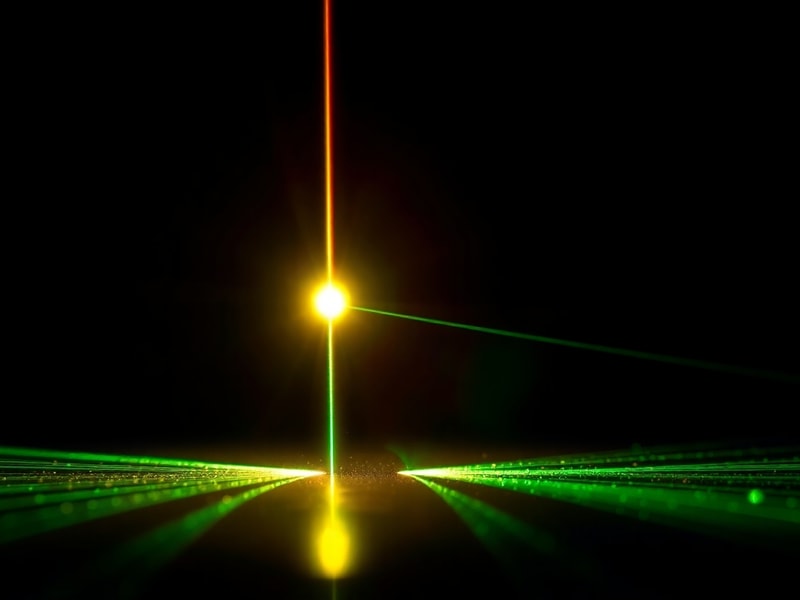
The mechanism behind photon splitting hinges on a process known as spontaneous parametric down-conversion (SPDC). This technique involves firing a high-energy photon into a nonlinear crystal, which then splits the photon into two lower-energy photons. These “daughter” photons are entangled, meaning their properties—such as polarization or momentum—are intrinsically linked, regardless of the distance separating them.
This phenomenon was first observed in the 1970s, but recent advancements in laser technology and materials science have refined the process. Scientists at institutions like the University of Vienna and the University of Queensland have pushed the boundaries of SPDC, achieving split photons with higher efficiency and precision. Their work is detailed in a recent study published in Nature Physics, which highlights the potential for split photons to revolutionize quantum encryption.
Beyond SPDC, other methods for splitting photons are being explored. For instance, researchers at the Massachusetts Institute of Technology have demonstrated photon splitting using quantum dots—nanoscale semiconductors that can trap and manipulate individual photons. These innovations underscore the global race to harness split photons for practical applications, from ultra-secure data transmission to ultra-precise sensors.
Global Implications and Collaborative Research
The implications of split photons extend far beyond the laboratory. Governments and private enterprises worldwide are investing in quantum technologies, recognizing their potential to disrupt industries. In Europe, the European Quantum Flagship program has allocated over €1 billion to quantum research, with photon splitting as a key focus. Meanwhile, China’s National Laboratory for Quantum Information Sciences has made significant strides in integrating split photons into quantum networks, aiming to create an unhackable communication infrastructure.
In the United States, the Department of Energy and DARPA are funding projects that explore split photons for defense applications, such as secure military communications and advanced imaging systems. Silicon Valley startups, including quantum computing firms like Rigetti and IonQ, are also exploring split photons as a building block for next-generation quantum computers. These efforts reflect a broader trend: the globalization of quantum research, where collaboration between nations and industries is as critical as competition.
Culturally, the fascination with split photons mirrors humanity’s enduring curiosity about the universe’s smallest components. From ancient Greek philosophers pondering the nature of light to modern-day scientists probing quantum mechanics, the quest to understand photons has been a unifying thread across civilizations. Today, split photons are not just a scientific curiosity; they are a symbol of humanity’s relentless pursuit of knowledge and innovation.
Challenges and Ethical Considerations
Despite the promise of split photons, significant challenges remain. One of the most pressing is scalability. While laboratory experiments have successfully split photons, translating these results into real-world applications demands further refinement. Issues such as photon loss, environmental interference, and the need for ultra-cold temperatures pose formidable obstacles. Researchers are tackling these problems through advances in cryogenics, materials science, and error correction algorithms.
Ethical considerations also come into play. The development of quantum technologies raises questions about privacy and security. While split photons could enable theoretically unhackable communication, they could also be misused for surveillance or cyber warfare. Policymakers and ethicists are grappling with how to regulate these technologies to ensure they benefit society without compromising individual freedoms. International bodies like the United Nations are beginning to address these concerns, but a unified framework remains elusive.
Another challenge is public perception. Quantum mechanics, with its counterintuitive principles, can be difficult to communicate to non-experts. Misunderstandings about split photons—such as the idea that they can be used to transmit information faster than light—could lead to unrealistic expectations or fears. Scientists and communicators must work together to demystify these concepts and foster informed public discourse.
Looking Ahead: The Future of Split Photons
The next decade will be pivotal for split photon research. Key milestones include the deployment of quantum networks that leverage split photons for secure communication, as well as the integration of split photons into quantum computing architectures. Companies like IBM and Google are already experimenting with hybrid quantum-classical systems, where split photons play a crucial role in error correction and qubit connectivity.
In the realm of fundamental science, split photons could help resolve long-standing mysteries about quantum gravity and the nature of spacetime. Some theories suggest that photons might “split” in extreme environments, such as near black holes or during the early moments of the universe. By studying split photons in controlled laboratory settings, scientists hope to gain insights into these cosmic phenomena.
For the average person, the most immediate impact of split photons may come in the form of enhanced technology. Imagine smartphones with quantum sensors that can detect minute changes in the environment, or medical imaging devices that provide unprecedented clarity without invasive procedures. The possibilities are as vast as they are exciting, but they will require sustained investment, collaboration, and public engagement to become a reality.
As we stand on the brink of a quantum revolution, split photons represent more than just a scientific curiosity—they are a testament to human ingenuity and the boundless potential of discovery. From the laboratories of Vienna to the quantum hubs of Silicon Valley, the journey to unlock the secrets of split photons is a global endeavor, one that promises to redefine the boundaries of technology and our understanding of the universe.