Hossam Abdelmaguid stands at the intersection of contemporary Egyptian art and global cultural dialogue. As one of the most prominent figures in the Middle East’s contemporary art scene, his work bridges traditional motifs with modern abstraction, creating a visual language that resonates far beyond Cairo’s galleries. Over the past two decades, Abdelmaguid has built a reputation for his experimental techniques, often blending calligraphic elements with geometric abstraction to explore themes of identity, memory, and societal transformation.
From Cairo to International Recognition
Born in 1977 in Giza, Egypt, Abdelmaguid grew up surrounded by the rich artistic heritage of Cairo. He studied at the Faculty of Fine Arts in Helwan, where he honed his skills in painting and sculpture. Early in his career, he was drawn to the interplay between East and West, a theme that continues to define his work. His breakthrough came in the early 2000s with exhibitions in Egypt and the broader Middle East, but it was his participation in the 2007 Sharjah Biennial that catapulted him onto the international stage.
Since then, his work has been showcased in major venues across Europe, Africa, and the United States, including the Centre Pompidou in Paris and the Mathaf: Arab Museum of Modern Art in Doha. Critics have praised his ability to merge abstract forms with cultural symbolism, creating pieces that feel both deeply personal and universally accessible. His 2018 solo exhibition at the Townhouse Gallery in Cairo, titled Lines of Flight, was a critical turning point, solidifying his role as a key voice in contemporary Arab art.
Abdelmaguid’s international success has not diluted his connection to Egypt. Instead, he uses his global platform to address local narratives, often challenging Western perceptions of Arab art. His work invites viewers to reconsider the boundaries between abstraction and representation, tradition and modernity.
Signature Style and Themes
Abdelmaguid’s artistic approach is marked by a deliberate ambiguity. His paintings often feature fragmented text, abstract shapes, and layered textures that evoke both calligraphy and modernist composition. This duality reflects his interest in the fluidity of meaning—how symbols can shift depending on context. In his 2020 series Echo Chambers, for example, he used overlapping geometric patterns to suggest the cacophony of contemporary life in Cairo, where tradition and rapid urbanization collide.
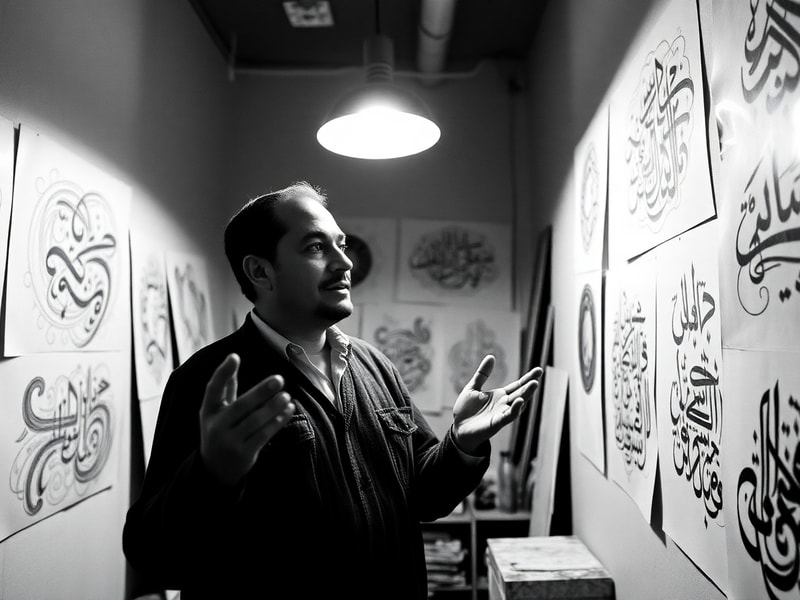
One of his most recurring motifs is the use of fragmented Arabic script, which he deconstructs into abstract forms. This technique serves as a commentary on language itself—how words carry weight, history, and emotion, yet can be stripped of their literal meaning to reveal something deeper. In an interview with Artforum, Abdelmaguid described this process as “painting silence,” a way to capture the unspoken tensions in society.
His work also engages with themes of displacement and belonging. Having traveled extensively for exhibitions, he often reflects on the experience of being an artist in diaspora. Yet his focus remains rooted in Egypt, particularly Cairo’s ever-changing urban landscape. His 2015 installation Cairo Mon Amour, featured at the Cairo Biennale, used discarded materials and architectural fragments to symbolize the city’s layered history and its uncertain future.
The following list highlights key elements of Abdelmaguid’s style:
- Deconstructed Calligraphy: Arabic script is broken down into abstract, rhythmic patterns.
- Layered Textures: Mixed media techniques create depth and tactile contrast.
- Urban Narratives: Cairo’s streets and architecture often serve as visual references.
- Political Subtext: His work subtly critiques authoritarianism and social inequality.
Cultural Impact and Legacy
Abdelmaguid’s influence extends beyond the canvas. He has been instrumental in mentoring younger Egyptian artists through initiatives at the Townhouse Gallery and the Contemporary Image Collective. His commitment to nurturing local talent reflects his belief in art as a tool for social change. In 2019, he co-founded the Culture section of Dave’s Locker, where he contributes essays on the intersection of art and society.
His work has also sparked important conversations about the representation of Arab artists in global art markets. Unlike many contemporaries who adapt to Western expectations of “Orientalist” aesthetics, Abdelmaguid maintains a distinctly Egyptian perspective. This has made him a figure of admiration—and occasional controversy—within both local and international art circles. Some critics argue that his abstraction can feel impenetrable to audiences unfamiliar with Arab visual culture, while others praise his refusal to simplify his vision for mass appeal.
Abdelmaguid’s impact is perhaps most visible in the rise of Egypt’s contemporary art scene. Galleries in Zamalek and Downtown Cairo now regularly feature artists inspired by his experimental approach. His 2022 retrospective at the Museum of Modern Egyptian Art in Cairo drew record crowds, proving that abstract art can hold its own in a region often dominated by figurative or politically charged works.
The Future of His Artistic Journey
Now in his late 40s, Abdelmaguid shows no signs of slowing down. His recent projects explore digital art and virtual reality, reflecting his ongoing engagement with new media. In 2023, he collaborated with technologists to create an immersive installation that reimagined Cairo’s Tahrir Square as a shifting, abstract landscape—part memory, part prophecy. This fusion of traditional painting with digital innovation signals a new chapter in his career.
Looking ahead, Abdelmaguid has expressed interest in creating large-scale public artworks in Egypt, particularly in marginalized communities. He envisions art as a catalyst for urban renewal, a way to reclaim public spaces from political neglect. His upcoming project, Neon Mirage, will transform a Cairo metro station into a glowing, text-based installation, blending poetry with light and movement.
As Egypt navigates economic instability and political uncertainty, artists like Abdelmaguid play a crucial role in preserving cultural identity. His work reminds us that art is not merely decorative—it is a form of resistance, a way to assert presence in a world that often seeks to erase difference. Whether through paint, sculpture, or digital media, he continues to challenge viewers to see beyond the surface.
For those new to his work, the best entry point may be his mid-career retrospective, Hossam Abdelmaguid: 2000–2020, which toured several international museums. The exhibition traces his evolution from early figurative works to his current abstract explorations, offering a comprehensive view of his artistic vision.
In a region where art is frequently politicized, Abdelmaguid’s commitment to abstraction feels like a quiet rebellion. He refuses to be boxed in by expectations—whether from the East or the West. Instead, he forges his own path, one brushstroke at a time.