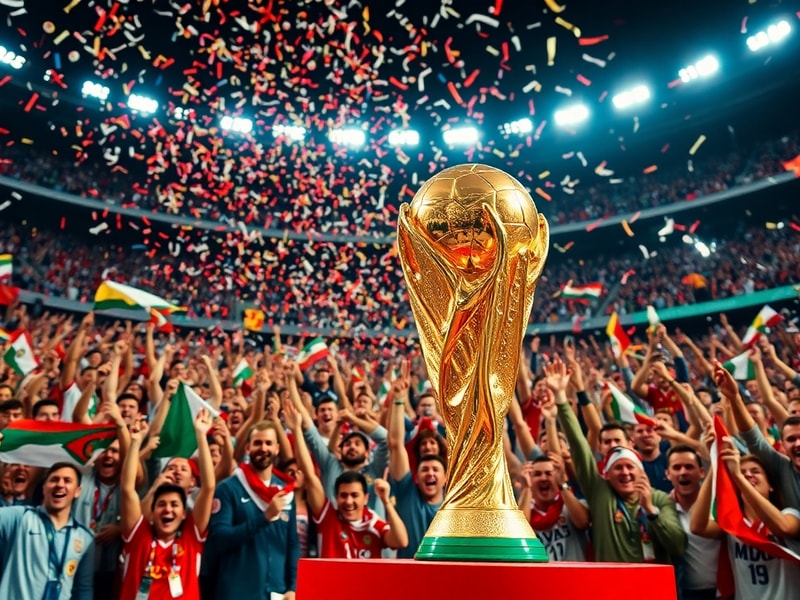
The Copa Mundial de Fútbol: A Global Phenomenon Beyond the Game
The FIFA World Cup, known in Spanish as the Copa Mundial de Fútbol, stands as the pinnacle of international football. Held every four years since 1930—with the exception of 1942 and 1946 due to World War II—the tournament brings together 32 national teams in a month-long spectacle watched by billions. More than just a sporting event, the World Cup is a global stage where nations unite, rivalries ignite, and legends are forged. It transcends borders, languages, and cultures, offering a rare moment of shared passion in an often divided world.
The evolution of the tournament: from humble beginnings to global spectacle
The first World Cup took place in Uruguay in 1930, featuring just 13 teams. The tournament was a modest affair by today’s standards, played in front of crowds that would be considered small even for a local league match today. Yet, it set the foundation for what would become the most-watched sporting event on Earth. By the 1950s, the World Cup had expanded to include teams from Europe, the Americas, and beyond, reflecting the growing influence of football across continents.
The 1970 World Cup in Mexico introduced color television broadcasting, bringing the tournament into living rooms worldwide. This technological leap transformed the event from a regional curiosity into a global phenomenon. The 1994 edition in the United States, for instance, drew over 3.5 million spectators and generated unprecedented commercial interest, proving that football could thrive beyond its traditional strongholds. Today, the World Cup is a multi-billion-dollar industry, with host nations investing billions in infrastructure, stadiums, and security to welcome the world.
The expansion to 48 teams, set for the 2026 tournament in the United States, Canada, and Mexico, will further democratize the competition. More nations than ever will have the chance to compete on the biggest stage, though critics argue that such growth may dilute the prestige of the tournament. Still, the World Cup remains a powerful symbol of unity, where nations that rarely interact on the global stage find common ground through sport.
Key moments that defined the Copa Mundial
Over the decades, the World Cup has produced countless unforgettable moments—some triumphant, others heartbreaking. These instances have shaped the tournament’s legacy and left an indelible mark on football history.
- 1950: Uruguay’s Miracle in Maracanã – Despite being underdogs, Uruguay defeated hosts Brazil 2-1 in the final, sparking celebrations across the country and cementing their place in football lore. The match remains one of the most iconic in World Cup history.
- 1966: England’s Only Triumph – Hosts England won their first and only World Cup, aided by a controversial goal in the final against West Germany. Geoff Hurst’s hat-trick and the “over the line” debate ensured the match would be debated for generations.
- 1970: Brazil’s Artistry – The Seleção of Pelé, Jairzinho, and Carlos Alberto played a brand of football that redefined the game. Their 4-1 victory over Italy in the final is often cited as the greatest World Cup final ever.
- 1986: Maradona’s Hand of God – Diego Maradona’s infamous “Hand of God” goal and his solo effort against England showcased both genius and controversy. Argentina went on to win the tournament, cementing Maradona’s status as a football deity.
- 1998: France’s Rise and Zidane’s Masterclass – Hosts France won their first World Cup, powered by a young Zinedine Zidane, who scored two headers in the final against Brazil. The victory marked the arrival of African and Arab football on the global stage.
- 2014: Germany’s 7-1 Thrashing of Brazil – In a match that stunned the world, Germany dismantled hosts Brazil in the semifinals, scoring seven goals in a humiliating defeat that became known as the “Mineirazo.”
These moments are more than just highlights—they reflect the drama, passion, and unpredictability that make the World Cup so compelling. Each tournament writes a new chapter in football’s greatest story, ensuring that the Copa Mundial remains a source of inspiration and debate.
The broader impact: beyond the pitch
The World Cup’s influence extends far beyond the 90 minutes on the field. Economically, the tournament is a boon for host nations, driving tourism, infrastructure development, and job creation. For example, the 2014 World Cup in Brazil injected an estimated $14 billion into the economy, though not without controversy over cost overruns and displacement of local communities.
Politically, the World Cup has often been a tool for soft power. Nations use the tournament to showcase their progress, stability, and cultural vibrancy. Qatar’s hosting of the 2022 World Cup, despite criticism over human rights issues, was a calculated move to elevate its global profile. Similarly, Russia’s 2018 World Cup was seen as an attempt to present a modern, progressive image of the country.
Socially, the World Cup fosters a sense of collective identity. Fans from diverse backgrounds come together to celebrate their shared love of football, transcending political, religious, and ethnic divides. The tournament also amplifies social issues, as seen in recent years with players taking a knee to protest racial injustice or teams wearing rainbow armbands in support of LGBTQ+ rights.
However, the World Cup is not without its controversies. Human rights abuses, corruption scandals, and environmental concerns have marred several editions. The 2022 World Cup in Qatar, for instance, faced widespread condemnation over the treatment of migrant workers involved in construction projects. Such issues force the football community to confront uncomfortable truths about the cost of global sporting events.
Despite these challenges, the World Cup endures as a symbol of hope and aspiration. It reminds us that, for a few weeks every four years, the world can come together to celebrate something greater than itself. The tournament’s ability to inspire, unite, and occasionally divide ensures its place as one of the most significant cultural events of our time.
What the future holds for the Copa Mundial
The World Cup is evolving, and with each edition, the stakes grow higher. The 2026 tournament in North America will be the largest in history, with 48 teams competing across three countries. This expansion reflects football’s global growth but also raises questions about the tournament’s identity. Will the World Cup retain its exclusivity and prestige, or will it become a sprawling, diluted spectacle?
Technological advancements are also reshaping the tournament. Video Assistant Referee (VAR) technology, introduced in 2018, has sparked debate over its impact on the game’s flow and fairness. Meanwhile, innovations like semi-automated offside technology promise to enhance the viewing experience while preserving the integrity of the sport.
Another trend is the increasing commercialization of the World Cup. Sponsorship deals, broadcasting rights, and digital engagement are driving revenue to unprecedented levels. While this financial growth benefits football’s governing bodies, it also raises concerns about the sport’s accessibility. Will the World Cup remain a tournament for the people, or will it become an exclusive event catering primarily to corporate interests?
Ultimately, the World Cup’s future depends on its ability to adapt while staying true to its core values: passion, competition, and unity. As football continues to grow, the tournament must navigate the challenges of expansion, technology, and commercialization without losing sight of what makes it so special. For millions of fans around the world, the Copa Mundial remains more than just a competition—it is a celebration of the beautiful game in all its glory.
The next chapter of the World Cup is already being written. Whether it’s the drama of a last-minute winner, the emergence of a new footballing superpower, or the unexpected heroism of a debutant nation, one thing is certain: the Copa Mundial will continue to captivate the world for generations to come.