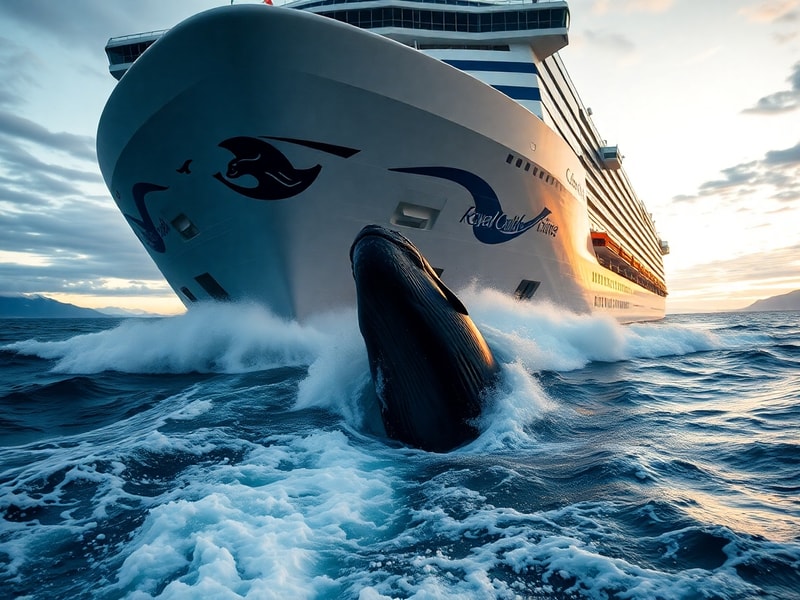
The collision between a Royal Caribbean cruise ship and a humpback whale off the coast of Alaska has reignited debates about maritime safety, environmental responsibility, and the growing impact of cruise tourism on fragile ecosystems. On the morning of June 12, the Symphony of the Seas—one of the world’s largest cruise vessels—struck a humpback near Juneau, leaving the animal injured and raising immediate concerns about the vessel’s response and the broader implications for whale protection in the region.
Witnesses aboard smaller boats described a sudden, violent impact followed by visible distress from the whale, which struggled to swim before disappearing beneath the surface. While Royal Caribbean confirmed the incident in a terse statement, details about the whale’s condition and the ship’s subsequent actions remain scarce. The company has not released footage or third-party assessments, fueling skepticism among conservationists and marine biologists.
The immediate aftermath and response
Local wildlife officials and the U.S. Coast Guard were notified within hours, but by the time responders arrived, the whale had vanished. Biologists from the Alaska Whale Foundation conducted an aerial search the following day but found no signs of the injured animal. This lack of closure has left many questions unanswered, particularly about whether the whale survived or succumbed to its injuries.
Royal Caribbean has not released the ship’s log or any internal review of the incident. The company stated only that the crew followed standard safety procedures and that the vessel continued its itinerary without delay. This response has drawn criticism from environmental advocates, who argue that the cruise industry’s emphasis on profit often overshadows ecological concerns.
Local tour operators, whose livelihoods depend on whale-watching excursions, expressed frustration over the lack of transparency. “These waters are a critical feeding ground for humpbacks,” said Captain Lisa Morrow of Juneau Whale Tours. “If large ships are cutting through here without caution, we’re putting species at risk that are already facing threats from climate change and vessel strikes.”
Why Alaska’s waters are a high-risk zone
Alaska’s Inside Passage is a seasonal migration route for thousands of humpback whales, drawn by abundant krill and herring. The region’s narrow channels and heavy maritime traffic—including commercial shipping, fishing boats, and cruise ships—create a perfect storm for collisions. Between May and September, nearly 40 large cruise vessels navigate these waters, each carrying thousands of passengers eager to spot marine life.
Unlike cargo ships, which often adhere to slower speed zones during peak whale season, cruise liners prioritize schedule reliability. This means maintaining near-constant speeds even in known whale habitats. A 2022 study by the University of Alaska Southeast found that vessel strikes are the leading cause of humpback whale mortality in the region, accounting for over 30% of documented deaths.
The Royal Caribbean incident is not an isolated case. In 2021, a Celebrity Cruises ship struck and killed a humpback near Glacier Bay National Park. The National Oceanic and Atmospheric Administration (NOAA) documented 14 whale-vessel collisions in Alaskan waters over the past five years, though many likely go unreported.
Under the Marine Mammal Protection Act, vessels involved in strikes must report the incident to NOAA within 48 hours. Royal Caribbean’s delayed acknowledgment—combined with the absence of a formal report—has raised concerns about compliance. NOAA officials have not confirmed whether an investigation is underway.
The cruise industry’s uneven track record on sustainability
Royal Caribbean has positioned itself as a leader in environmental innovation, touting advanced wastewater treatment systems and the use of liquefied natural gas (LNG) in newer ships. However, critics argue that these efforts are overshadowed by the company’s role in accelerating whale fatalities and carbon emissions. The Symphony of the Seas, for example, emits roughly 25% more CO2 per passenger than a mid-sized commercial airliner.
Industry-wide, cruise companies have faced increasing scrutiny over their environmental impact. A 2023 report by the environmental group Travel Watch found that the top three cruise lines—Royal Caribbean, Carnival, and Norwegian—were responsible for over 10 million tons of CO2 emissions in 2022, equivalent to the annual output of 2.2 million cars. Whale strikes, while less discussed, represent a more immediate ecological cost.
Some cruise lines have begun adopting whale-safe navigation measures, such as reduced speeds in critical habitats and onboard marine biologists to monitor wildlife. Norwegian Cruise Line, for instance, implemented a voluntary slow-speed zone in parts of the Inside Passage after a series of strikes in 2020. Royal Caribbean has not followed suit, citing operational challenges.
Environmental groups are calling for stricter federal regulations. The Center for Biological Diversity has petitioned NOAA to expand mandatory speed restrictions in Alaskan waters and require real-time whale-detection technology on all large vessels. “We can’t keep treating these incidents as unfortunate accidents,” said Rose Sortor, a marine policy advocate. “They’re the result of systemic negligence.”
What’s next for whale protection in Alaska?
The Royal Caribbean incident has prompted calls for greater accountability, but meaningful change will require coordination between regulators, cruise companies, and local communities. NOAA is reviewing its current guidelines, which critics argue are outdated and poorly enforced. One proposal under consideration is the creation of a dedicated whale-strike response team, equipped with drones and thermal imaging to locate injured animals quickly.
For now, the fate of the humpback remains unknown. Without a body or clear evidence of injury, officials cannot confirm whether the strike was fatal. However, the incident has already had a tangible effect on tourism. Several Juneau-based whale-watching tours have reported cancellations as passengers voice concerns about the safety of the animals they came to see.
Long-term solutions may lie in technology. Startups like Whale Safe, a detection system developed by the Benioff Ocean Initiative, use AI to analyze underwater acoustics and alert ships to nearby whales. While still in pilot phases, such tools could become industry standards if proven effective. Royal Caribbean has not indicated whether it would adopt such measures.
As cruise season peaks in Alaska, the pressure on companies like Royal Caribbean to prioritize safety over schedules will only grow. For now, the Symphony of the Seasons sails on, its passengers unaware—or perhaps indifferent—to the ecological toll of their voyage. But in a region where whales are both a cultural icon and a barometer of environmental health, the cost of complacency may soon become impossible to ignore.