Swift’s Sudden Silence and NASA’s Race Against Time
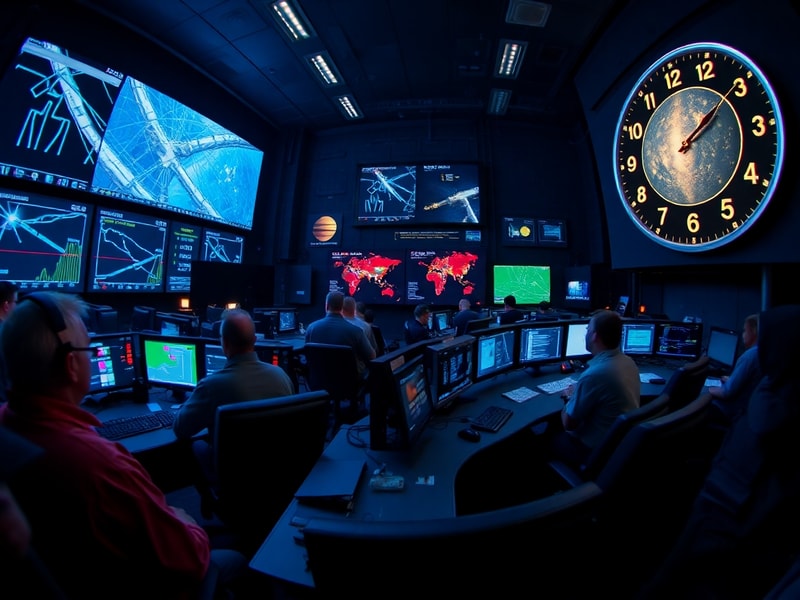
The night of March 15, 2024, began like any other for astronomers tracking signals from deep space. The NASA Neil Gehrels Swift Observatory had spent nearly two decades scanning the cosmos for gamma-ray bursts, X-ray flashes, and other high-energy phenomena, relaying critical data to scientists around the world. But on that night, the spacecraft fell silent. Communication links between Swift and Earth flickered and failed, leaving mission controllers at the Goddard Space Flight Center staring at empty screens and a growing sense of urgency.
The cause wasn’t immediately clear. Was it a software glitch? A hardware failure? Or something more ominous? Within hours, teams at NASA, Penn State University (which leads the science operations), and international partners activated contingency plans. What followed was a global effort involving engineers, scientists, and even amateur astronomers—each playing a role in diagnosing and recovering one of NASA’s most resilient space telescopes.
Swift wasn’t just another satellite. Launched in 2004, it had revolutionized our understanding of gamma-ray bursts—brief but brilliant explosions marking the deaths of massive stars or the mergers of neutron stars. These events, invisible to the naked eye, had once been mysterious. But Swift’s rapid slewing capability allowed it to pivot and observe them within seconds, turning fleeting cosmic flashes into lasting scientific breakthroughs. By 2024, it had detected over 1,600 gamma-ray bursts and hundreds of other transient events, from supernovae to tidal disruption flares.
Its loss would have been a blow not only to astrophysics but to the global scientific community that relied on its data. So when the signal vanished, the response was swift—and global.
Decoding the Blackout: What Went Wrong in Orbit
Initial telemetry suggested a power anomaly. The spacecraft’s solar panels, essential for keeping batteries charged, were no longer generating expected voltage. Engineers suspected a malfunction in the attitude control system, which stabilizes the spacecraft and points its instruments accurately. Without stable orientation, the solar arrays couldn’t track the Sun effectively, leading to a dangerous drop in power.
Further investigation pointed to a potential failure in one of the reaction wheels—components that help Swift maintain precise pointing. Reaction wheels are critical for fine adjustments, and if one fails, the system compensates by using others. But a cascade effect could overload the remaining wheels, leading to a loss of control. That appeared to be exactly what happened.
The team traced the issue back to a software update pushed in late February. While intended to improve autonomous recovery from anomalies, the update may have inadvertently triggered a fault in the wheel management system. In the vacuum of space, even minor software interactions can have outsized consequences. It was a reminder that in space exploration, redundancy is king—but even redundancy has limits.
By day three, mission engineers had developed a workaround. They disabled the faulty reaction wheel and reconfigured the spacecraft to use its thrusters for coarse pointing, supplemented by magnetic torquers to stabilize orientation. It wasn’t graceful, but it worked. Swift’s solar arrays slowly turned toward the Sun, and power levels began to climb. Within a week, the telescope was back online, though operating in a reduced capacity.
Global Collaboration: How the World Helped Bring Swift Back
Swift’s rescue wasn’t just a NASA operation—it was a testament to international collaboration. Scientists from Italy, the UK, Germany, and Japan contributed real-time data analysis and ground-based observations to help confirm the spacecraft’s status and refine recovery strategies. Amateur astronomers in Australia and Chile used optical telescopes to search for Swift’s gamma-ray burst counterparts, ensuring the broader science community didn’t miss critical events during the blackout.
The recovery effort followed a structured but flexible protocol:
- Tier 1 – Immediate Response: Goddard Space Flight Center and Penn State activated emergency protocols, rerouting communications through alternate ground stations in Alaska and Spain to maximize contact windows.
- Tier 2 – International Coordination: ESA’s Malindi ground station in Kenya provided additional tracking support, while the Italian Space Agency (ASI) offered data relay via the AGILE satellite.
- Tier 3 – Scientific Backup: Global networks like the Gamma-ray Coordinates Network (GCN), managed by NASA, distributed alerts to over 2,000 registered observers, ensuring no transient events went unnoticed.
- Tier 4 – Public and Educational Engagement: NASA launched a live blog and social media updates, inviting the public to follow the recovery in real time—a move that bolstered transparency and global interest in space science.
This level of coordination reflects a broader shift in space science: from isolated national efforts to interconnected, open networks. In an era where space telescopes like James Webb and Hubble rely on global partnerships, Swift’s recovery underscored how science transcends borders. It also highlighted the role of citizen science, with amateur astronomers contributing crucial observations that filled gaps in professional monitoring.
Lessons from the Blackout: What Swift’s Rescue Teaches Us About Space Resilience
Swift’s near-loss and recovery offer several key insights into the future of space operations. First, the incident reaffirmed the importance of redundancy—not just in hardware, but in software and communication pathways. While Swift had backup systems, a single update nearly compromised the entire mission. That raises questions about how much autonomy we should give to AI-driven systems in space, especially as missions grow more complex.
Second, the global response demonstrated the value of transparent, open data sharing. During the blackout, NASA’s public updates kept the scientific community informed and prevented duplication of efforts. This approach not only accelerated recovery but also fostered trust across international teams.
Third, the event highlighted the vulnerability of aging space assets. Launched in 2004 with a five-year design life, Swift had far exceeded expectations. But its longevity came with risks. Many of today’s space telescopes are operating well beyond their intended lifespans, raising concerns about preparedness for future failures. NASA and ESA are now investing in next-generation missions like the Swift2 concept and the Transient Explorer, designed with built-in fail-safes and modular upgrades.
Finally, Swift’s recovery underscores a cultural shift in how we view space missions. They are no longer seen as isolated technical feats but as shared human achievements that inspire curiosity across generations. When the telescope resumed operations, social media erupted with messages of relief and celebration. Students wrote essays about its resilience, and artists created digital tributes. In Japan, a popular science YouTuber streamed a live observation session using Swift data, drawing over 50,000 viewers.
Such engagement is vital. In an age where space exploration often competes with entertainment and misinformation, stories like Swift’s remind the public why science matters. They show that behind every data point is a team of humans solving problems under pressure, and that the universe is still full of mysteries waiting to be uncovered.
Swift’s Future: Beyond Recovery, Toward a New Era
Now fully operational again, Swift continues its mission with renewed appreciation. Its near-loss has led to improved monitoring of reaction wheel performance and stricter software validation protocols. NASA has also implemented a “cold spare” reaction wheel on standby, ready to be activated if needed. These changes reflect a broader trend in space science: learning from failure to build more resilient systems.
Looking ahead, Swift is poised to play a key role in multi-messenger astronomy—the coordinated observation of cosmic events using light, neutrinos, and gravitational waves. Its rapid response capability makes it ideal for following up on alerts from observatories like LIGO or IceCube, helping scientists piece together the story of cataclysmic events across the universe.
The telescope’s story is also one of inspiration. In classrooms from Brazil to India, students are learning about Swift not just as a machine, but as a testament to human ingenuity and perseverance. It’s a reminder that in the vastness of space, even the smallest signal—a flicker of gamma rays, a pulse of X-rays—can carry the story of a star’s death, a galaxy’s birth, or the echoes of creation itself.
As Swift continues to scan the skies, its legacy is already secure. It has taught us that space missions are not just about launching rockets or deploying telescopes—they’re about resilience, collaboration, and the unyielding human drive to explore the unknown. And in a universe that often feels indifferent, that might be the most profound discovery of all.