Ronaldinho: The Smile That Changed Football Forever
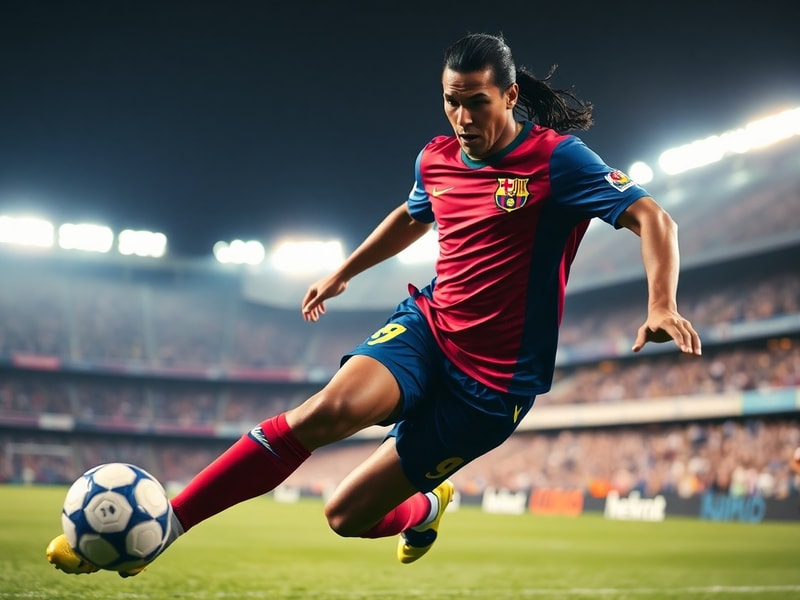
Few players in football history have carried the ball with the same joy as Ronaldo de Assis Moreira—better known as Ronaldinho. His dribbling wasn’t just skill; it was a form of art, a spectacle that made stadiums erupt and defenders look foolish. From the concrete pitches of Porto Alegre to the grand stages of Europe, Ronaldinho redefined what it meant to play with freedom and creativity. He didn’t just win games; he made people smile, and that smile became as iconic as his stepovers.
The Early Years: From Humble Roots to Global Recognition
Born on March 21, 1980, in the Vila Nova neighborhood of Porto Alegre, Brazil, Ronaldinho grew up in a family deeply connected to football. His father, João, worked as a shipyard worker and played amateur football, while his older brother Roberto played professionally. Tragedy struck early when João passed away when Ronaldinho was eight, leaving a profound impact on him. Football became both an escape and a way to honor his father’s memory.
At 13, he scored all 23 goals in a 23–0 youth tournament victory, a feat that hinted at the prodigious talent to come. His technical ability and flair were evident from the beginning, but it was his character that set him apart. He played barefoot in street matches, mastering the ball on uneven surfaces. Scouts took notice, and by age 17, he made his professional debut for Grêmio in Brazil’s top flight. Though the club struggled financially, Ronaldinho’s performances kept them competitive and drew attention from European scouts.
His breakthrough came at the 1999 FIFA World Youth Championship in Nigeria, where he captained Brazil to victory and won the Golden Ball as the tournament’s best player. That performance caught the eye of Paris Saint-Germain, which signed him in 2001. The move to Europe was a turning point, though it wasn’t an immediate success. Cultural adjustments and limited playing time made his first year challenging. Yet, his potential was undeniable, and by the 2002–03 season, he began to shine, forming a dynamic partnership with Brazilian compatriot Raí.
The Barcelona Renaissance: A Magician in Camp Nou
Ronaldinho’s arrival at FC Barcelona in the summer of 2003 marked the beginning of a golden era for the Catalan club. The club was in financial turmoil and had just been relegated to the second division, but the signing of a 23-year-old Ronaldinho signaled a new direction. His first touch, his balance, and his ability to glide past opponents redefined how the game could be played. In his debut season, he led Barcelona to a second-place finish in La Liga and won the FIFA World Player of the Year award.
The 2004–05 campaign was nothing short of magical. Ronaldinho formed a lethal trio with Samuel Eto’o and Ludovic Giuly, orchestrating a relentless attack that dismantled defenses week after week. His performance against Real Madrid in November 2005—where he scored two goals and assisted another in a 3–0 win at the Santiago Bernabéu—remains one of the most celebrated individual displays in El Clásico history. That season, Barcelona won La Liga, and Ronaldinho was named FIFA World Player of the Year for the second time.
What made Ronaldinho so special wasn’t just his skill, but his timing. He played with a metronomic rhythm, often waiting for the perfect moment to unleash a dazzling move. His no-look passes, feints, and audacious tricks weren’t just for show—they were tools of deception that left defenders disoriented. Yet, despite the glamour, he remained grounded. He celebrated goals with a smile, hugged teammates, and never forgot his roots.
His legacy at Barcelona is immortalized not just in trophies, but in the way he restored the club’s identity. Under his influence, Barcelona transitioned from a struggling giant to a team that played with artistry and confidence. Players like Lionel Messi, then a teenager, looked up to him. The foundations he helped lay would later bloom into the era of tiki-taka and global dominance.
International Glory and the 2002 World Cup
While Ronaldinho’s club career is legendary, his international career is defined by one unforgettable tournament: the 2002 FIFA World Cup in South Korea and Japan. Playing alongside Ronaldo, Rivaldo, and Cafu, he formed the backbone of a fearsome Brazilian attack. Though often overshadowed by Ronaldo’s goal-scoring prowess, Ronaldinho’s creativity was the spark that ignited Brazil’s campaign.
His performance in the group stage against England is etched in World Cup lore. With Brazil trailing 1–0, Ronaldinho received the ball just outside the box, took a quick touch, and unleashed a curling shot that flew into the top corner. That goal, a masterpiece of technique and audacity, changed the game and swung momentum. Brazil went on to win 2–1, and Ronaldinho was named Man of the Match.
He played a pivotal role in the quarterfinal against England and the semifinal against Turkey, providing crucial assists and controlling the tempo. Though he missed the final due to suspension (after receiving a second yellow card in the quarterfinal), his influence was undeniable. Brazil defeated Germany 2–0 in the final, securing their fifth World Cup title. Ronaldinho’s joy and charisma made him a global icon overnight, and he was awarded the Bronze Ball as the tournament’s third-best player.
Beyond the World Cup, Ronaldinho represented Brazil in multiple Copa América and Confederations Cup tournaments. He won the 2004 Copa América and the 2005 FIFA Confederations Cup, where he was named Player of the Tournament. His partnership with Adriano and Kaká formed one of the most entertaining Brazilian teams of the mid-2000s.
Legacy and Influence: The Ronaldinho Effect
Ronaldinho’s career spanned nearly two decades, playing for clubs in Brazil, France, Spain, Italy, and Mexico. After leaving Barcelona in 2008, he joined AC Milan, where he won Serie A in 2011. Though his time in Italy was shorter, his performances against Juventus and Roma showcased his enduring brilliance. He later returned to Brazil with Flamengo and Atlético Mineiro, winning the Copa Libertadores in 2013—a crowning achievement in his club career.
His influence extended far beyond statistics. Ronaldinho redefined the role of a playmaker. He proved that football could be joyful, that skill could coexist with success, and that entertainment didn’t have to come at the expense of results. He inspired a generation of players, from Messi to Neymar, who grew up watching him dribble past entire teams with a grin.
Off the pitch, Ronaldinho’s personality made him a global ambassador for the sport. Known for his generosity, humor, and love of life, he became a cultural icon. He appeared in commercials, music videos, and even starred in his own video game. Despite financial challenges later in life, his legacy as one of football’s most beloved figures remains intact.
Today, Ronaldinho is often remembered not just as a footballer, but as an artist. His legacy is preserved in highlights, documentaries, and tributes across the football world. Clubs like Barcelona and Atlético Mineiro have honored him, and younger generations continue to discover his magic through archives and social media.
Ronaldinho’s story is a reminder that football is more than a sport—it’s a celebration of life. His dribbling, his smile, and his freedom on the pitch made him timeless. In a world often defined by intensity and pressure, Ronaldinho played with pure joy—and that may be his greatest lesson of all.