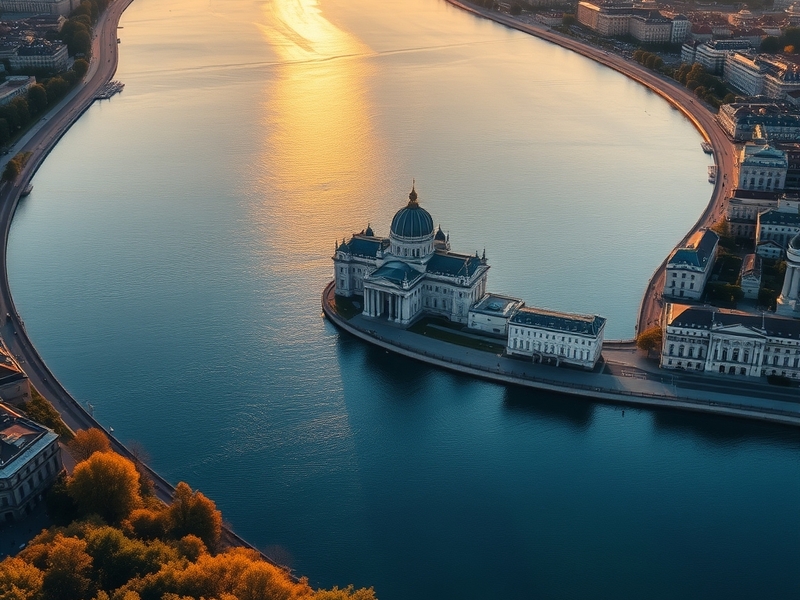
The Danube River stretches 2,850 kilometers across Europe, making it the continent’s second-longest waterway after the Volga. Originating in Germany’s Black Forest, it flows through ten countries—Germany, Austria, Slovakia, Hungary, Croatia, Serbia, Romania, Bulgaria, Moldova, and Ukraine—before emptying into the Black Sea. This remarkable journey connects diverse cultures, economies, and ecosystems, shaping the history of Central and Eastern Europe in ways few other natural features have.
The river’s strategic importance has been recognized since ancient times. The Romans built one of their most vital trade routes along its banks, the limes, which served as both a military frontier and a commercial highway. Even today, the Danube remains a lifeline for millions, supporting industries from agriculture to shipping while serving as a natural boundary and a source of inspiration for art and literature.
The Danube’s geography and ecological significance
The Danube’s basin covers approximately 817,000 square kilometers, draining water from 19 countries. Its most dramatic section lies in the Iron Gates, a series of gorges between Romania and Serbia where the river narrows and drops 34 meters in just 134 kilometers. This area, once a barrier to navigation, now hosts hydroelectric dams that power entire regions.
Ecologically, the Danube is one of Europe’s most biodiverse rivers. The Danube Delta in Romania, a UNESCO World Heritage Site, is home to over 3,400 species of plants and animals, including pelicans, wildcats, and the endangered sturgeon. Wetlands along the river act as natural filters, purifying water before it reaches the Black Sea. Yet this ecosystem faces threats from pollution, invasive species, and climate change, which could disrupt the delicate balance of life sustained by the river.
The Danube’s floodplains also play a crucial role in flood control. During heavy rains, these areas absorb excess water, reducing the risk of catastrophic flooding downstream. However, urbanization and deforestation have reduced the river’s natural floodplains by more than 80% in some sections, increasing the vulnerability of cities like Budapest and Vienna to extreme weather events.
Cultural and historical landmarks along the Danube
The river has been a stage for human civilization for millennia. In Vienna, the Danube inspired composers like Strauss, whose Blue Danube waltz became an unofficial anthem of the city. Budapest owes its nickname, “Queen of the Danube,” to its stunning architecture, including the Parliament Building and the Fisherman’s Bastion, both illuminated at night to dramatic effect.
Further downstream, the medieval fortress of Golubac in Serbia stands as a testament to the river’s role in medieval warfare. The Ottomans and Hungarians clashed repeatedly over control of this strategic point, and its ruins still echo with centuries of history. Meanwhile, the Iron Gates Gorge holds traces of prehistoric settlements, including the 7,000-year-old Lepenski Vir, where early humans carved figures into the rocks.
The Danube also flows through cities that have shaped Europe’s political and cultural identity:
- Bratislava, Slovakia: Home to one of Europe’s best-preserved medieval city centers, with a castle that overlooks the river and a lively arts scene.
- Belgrade, Serbia: A fortress city where the Danube meets the Sava River, blending Ottoman, Austro-Hungarian, and Yugoslav influences.
- Ruse, Bulgaria: Known as the “Little Vienna” for its 19th-century architecture, including the stunning National Museum of Transport.
These cities highlight how the Danube has been both a divider and a connector, fostering trade and cultural exchange while also serving as a battleground during wars.
Modern challenges and the future of the Danube
Today, the Danube faces pressures from industrial pollution, agricultural runoff, and the construction of new dams. The Gabčíkovo-Nagymaros Project, a joint venture between Slovakia and Hungary, sparked controversy in the 1980s and 1990s due to its environmental impact. While the dams provided hydroelectric power, they also altered water flows and disrupted fish migration patterns, leading to long-term ecological consequences.
Climate change poses another existential threat. Rising temperatures reduce water levels in some sections, making navigation more difficult for cargo ships. The Danube’s role as a transportation artery is vital for Europe’s economy, carrying goods between inland ports and the Black Sea. In 2022, low water levels forced some shipping companies to reduce loads, costing millions in lost revenue.
Efforts to restore the Danube’s health are underway. The International Commission for the Protection of the Danube River (ICPDR) coordinates conservation projects across member states, focusing on reducing plastic waste, improving wastewater treatment, and reconnecting floodplains. Meanwhile, cities along the river are investing in green infrastructure, such as floating wetlands in Vienna that filter pollutants and provide habitats for wildlife.
The Danube’s future depends on balancing economic needs with environmental stewardship. Innovations like electric cargo ships and solar-powered riverboats could reduce pollution, while stricter regulations on industrial discharge might improve water quality. Yet without coordinated action, the river’s ecosystems—and the communities that depend on them—could face irreversible damage.
Why the Danube matters today
The Danube is more than just a river; it is a symbol of Europe’s interconnectedness. It has witnessed empires rise and fall, cultures blend, and technologies evolve. From the ancient Romans to modern-day environmentalists, generations have relied on its waters for survival, inspiration, and progress.
As climate change and human activity reshape the continent, the Danube’s story is far from over. Its waters carry the weight of history, but they also flow toward an uncertain future. Protecting this vital resource requires cooperation across borders, innovative solutions, and a commitment to preserving one of Europe’s greatest natural treasures. For travelers, historians, and ecologists alike, the Danube remains a source of wonder—and a reminder of nature’s enduring power.