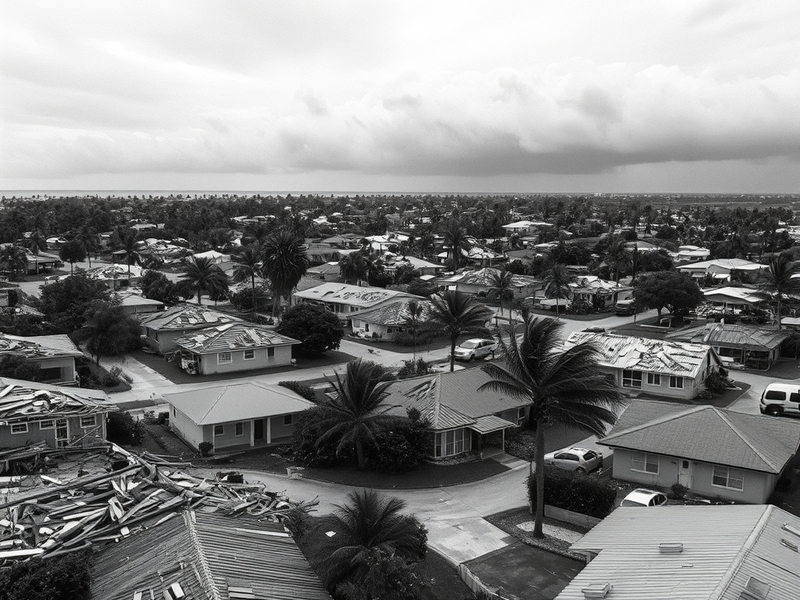
The morning of August 24, 1992, began like any other in South Florida, but by noon the landscape had been permanently rewritten. Hurricane Andrew arrived with a fury that stunned meteorologists and reshaped emergency planning across the United States. In just a few hours, the Category 5 storm carved a 25-mile-wide path of destruction from Homestead to Kendall, leaving 65 dead and more than 160,000 people homeless. What made Andrew exceptional wasn’t just its wind speeds or storm surge—it was the way the storm exposed weaknesses in building codes, disaster response, and public awareness that had gone unaddressed for decades.
How Hurricane Andrew Became a Category 5 Beast
Andrew didn’t start as a monster. It began as a tropical wave off the coast of West Africa in mid-August, drifting westward with little organization. By August 17, it had gained enough structure to be classified as a tropical depression. Forecasters initially expected it to curve north and weaken, a common path for late-summer storms. But high pressure to the north blocked that escape route, steering Andrew straight into the Caribbean.
As it moved over unusually warm waters near the Bahamas, rapid intensification took hold. On August 22, Andrew’s sustained winds jumped from 85 mph to 115 mph in just six hours. By the time it struck northern Eleuthera in the Bahamas, it was already a Category 4 storm. Yet the real transformation happened as it crossed the Straits of Florida. A meteorological perfect storm of low wind shear and warm Gulf Stream waters allowed Andrew to reorganize and explode to Category 5 strength just before landfall in Florida.
The National Hurricane Center recorded sustained winds of 165 mph with gusts over 180 mph at the National Hurricane Center’s temporary facility in Coral Gables—levels that would later be revised upward after reanalysis. For context, those winds stripped bark from trees, flattened entire neighborhoods, and generated a storm surge of up to 17 feet in Biscayne Bay. The pressure at landfall dropped to 922 millibars, making Andrew the third-strongest U.S. hurricane at the time, behind only the 1935 Labor Day Hurricane and Hurricane Camille in 1969.
The Human and Economic Toll That Defined a Generation
When the eye passed over southern Miami-Dade County, it wasn’t just buildings that were destroyed—entire communities were erased. The Homestead Air Force Base, a critical military installation, was nearly leveled. Mobile homes in Florida City were reduced to splinters. The Cutler Ridge neighborhood saw roofs torn off and walls collapsed inward, as if a giant fist had punched through from the outside. More than 63,000 homes were damaged or destroyed, and an estimated 1.4 million people were left without power for weeks.
The economic damage reached $27 billion at the time, making Andrew the costliest hurricane in U.S. history until Hurricane Katrina in 2005. Insurance companies nearly collapsed under the weight of claims. Eleven insurers went bankrupt, and the state had to create the Florida Hurricane Catastrophe Fund to stabilize the market. More than 250,000 people were forced into temporary shelters, many of which were themselves damaged or overcrowded. The psychological scars ran deep—studies later showed elevated rates of depression and post-traumatic stress among survivors for years.
Recovery was uneven. While affluent areas like Coral Gables and parts of Miami rebounded relatively quickly, poorer neighborhoods such as Homestead and Florida City struggled for years. Rebuilding codes were tightened, but the financial burden fell hardest on low-income families. Displacement led to a demographic shift, with many longtime residents unable to return, altering the cultural fabric of South Florida for a generation.
Lessons Learned: How Andrew Changed Disaster Preparedness Forever
Andrew exposed a cascade of failures that forced a fundamental rethinking of how America prepares for hurricanes. Before 1992, building codes in Florida were inconsistent and often outdated. Many homes built in the 1970s and 1980s used hollow-core concrete blocks for exterior walls, which offered little resistance to windborne debris. Roof-to-wall connections were weak, and garage doors frequently failed, leading to catastrophic structural collapses. The storm revealed that even modern homes could not withstand sustained winds above 120 mph.
In response, Florida adopted the Florida Building Code in 2002, one of the strictest in the nation. It mandated impact-resistant windows, reinforced garage doors, and stronger roof-to-wall connections. The code also introduced a statewide system for enforcing construction standards, eliminating the patchwork of local rules that had allowed substandard construction to persist. These changes didn’t just apply to new homes—existing structures in high-risk zones were required to retrofit vulnerable components.
Emergency response systems were also overhauled. Before Andrew, the National Hurricane Center relied on a single radar site in Miami and limited real-time data from reconnaissance aircraft. Today, the agency uses a network of Doppler radars, GPS dropwindsondes, and high-resolution satellite imagery. Evacuation planning became more sophisticated, with clearer zones and better communication strategies. The Federal Emergency Management Agency (FEMA), criticized for its slow and disorganized response to Andrew, reorganized its disaster response model, emphasizing local control and rapid deployment of resources.
The insurance industry’s near-collapse led to significant reforms as well. State-backed insurers of last resort, like Citizens Property Insurance Corporation, were created to ensure coverage in high-risk areas. Reinsurance markets were restructured to better spread risk globally. These changes helped stabilize the market, though debates about affordability and risk distribution continue today.
Public awareness campaigns also evolved. Before Andrew, many South Florida residents underestimated the danger of hurricanes, believing that modern construction made them safe. After the storm, education campaigns emphasized the unpredictability of storm surges, the importance of evacuation orders, and the need for personal preparedness. The slogan “Run from the water, hide from the wind” became ingrained in coastal culture.
Andrew’s Legacy: A Cautionary Tale for a Warming Climate
Three decades later, Hurricane Andrew remains a touchstone in the conversation about climate change and hurricane risk. While no single storm can be attributed directly to global warming, Andrew occurred during a period of rising ocean temperatures and shifting atmospheric patterns that climate models suggest will produce more intense hurricanes. The Intergovernmental Panel on Climate Change (IPCC) has noted that Category 4 and 5 storms are likely to become more frequent, with stronger winds and heavier rainfall.
South Florida’s vulnerability has only increased since 1992. Sea levels have risen by about six inches in Miami since Andrew, amplifying the threat of storm surge. The region’s population has grown by more than 1.5 million people, many of whom have never experienced a major hurricane. Insurance premiums have soared, and some homeowners in high-risk zones now face annual costs exceeding $10,000. The state has invested billions in flood mitigation projects, but critics argue the efforts remain insufficient.
Andrew also highlighted the disproportionate impact of disasters on marginalized communities. Research by the Culture and Analysis sections of Dave’s Locker has shown that low-income and minority neighborhoods often face longer recovery times and greater long-term displacement. The storm’s legacy compels ongoing scrutiny of equity in disaster policy, from zoning laws to relief distribution.
Looking ahead, Andrew’s lessons are more relevant than ever. Cities like Miami are experimenting with “resilience hubs,” retrofitting buildings to serve as shelters and community centers during disasters. Advanced forecasting models, such as those using artificial intelligence, are being developed to predict storm intensification with greater accuracy. Yet the core challenges remain: balancing growth with safety, ensuring affordability in high-risk zones, and preparing for storms that may surpass historical precedents.
For those who lived through Andrew, the storm is not just a historical event—it’s a defining moment that reshaped their understanding of nature’s power and human fragility. For younger generations, it serves as a reminder that preparedness is not optional. As climate change intensifies the threat of extreme weather, Andrew’s legacy is a call to action, not just in Florida, but across the coastal United States.