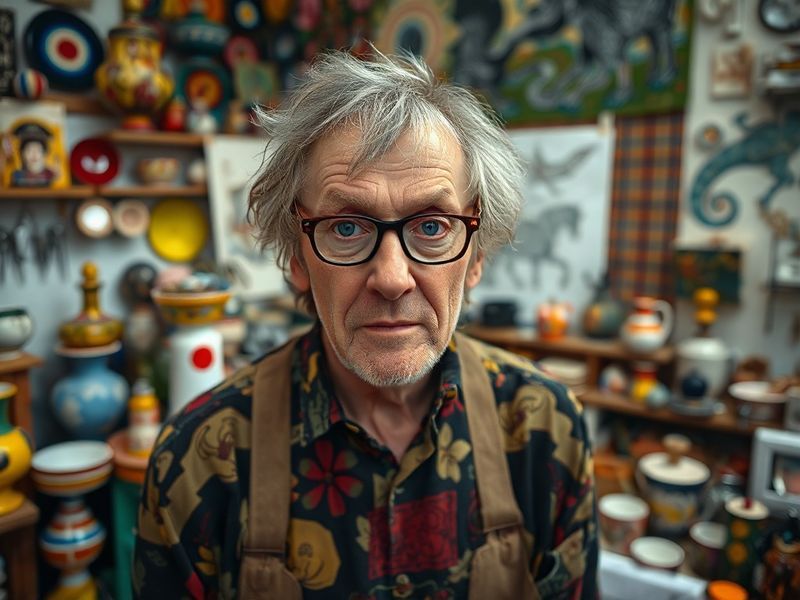
Grayson Perry stands as one of the most provocative and compelling figures in contemporary art. Known for his unapologetic exploration of identity, gender, and societal norms, Perry has spent decades challenging conventions while earning widespread acclaim. His work—ranging from ceramics to tapestries, from television documentaries to public lectures—blurs the lines between high art and popular culture.
Born in 1960 in Chelmshott, England, Perry initially gained recognition in the 1980s and 1990s as part of the “Young British Artists” movement, alongside figures like Damien Hirst and Tracey Emin. Unlike many of his contemporaries, however, Perry did not restrict himself to a single medium. Instead, he embraced versatility, using ceramics—a traditionally domestic and decorative art form—as a vehicle for sharp social commentary. His pieces often feature bold, colorful designs juxtaposed with unsettling imagery, forcing viewers to confront uncomfortable truths about modern life.
The Artistic Evolution: From Ceramics to Cultural Commentary
Perry’s early ceramic works, such as Vase (1994) and Vase (The Disappearing Landscape), established his reputation as an artist unafraid to tackle complex themes. These pieces often incorporated autobiographical elements, including his alter ego, “Claire,” a flamboyant, pink-clad transvestite. Through Claire, Perry explored themes of gender fluidity and self-representation long before such topics entered mainstream discourse.
By the 2000s, Perry expanded his repertoire into large-scale tapestries, such as Walthamstow Tapestry (2009), which depicted a satirical map of the British class system. These works demonstrated his ability to merge craftsmanship with biting critique, earning him comparisons to historical satirists like William Hogarth. His tapestries often feature intricate detail and vibrant colors, drawing viewers in before revealing the underlying social commentary.
In 2013, Perry took his cultural commentary to television with Who Are You?, a documentary series in which he explored identity in modern Britain. The show followed individuals undergoing profound personal transformations, from a transgender woman to a former gang member. Perry’s empathetic yet critical approach highlighted his role not just as an artist, but as a cultural observer.
The Transgressive Power of Ceramics
Perry’s choice of ceramics as his primary medium was, in itself, a form of rebellion. Traditionally associated with craft rather than fine art, ceramics were often dismissed as “women’s work” or mere decorative objects. By elevating this medium to the realm of high art, Perry challenged long-standing hierarchies in the art world. His pieces often reference historical pottery styles, such as Wedgwood or Delftware, but subvert them with contemporary themes—pornography, war, consumerism, and identity politics.
One of his most famous works, Map of Truths and Beliefs (2011), features a ceramic map of the world inscribed with slogans and symbols representing different belief systems. The piece reflects Perry’s interest in how ideology shapes society, a theme that resonates globally. His ability to merge beauty with provocation has made his work accessible to audiences beyond traditional art circles, bridging gaps between elitism and populism.
- Ceramics as Social Critique: Perry’s use of ceramics allowed him to reach audiences who might not typically engage with contemporary art, making his messages more widely accessible.
- Historical References: By drawing on traditional pottery styles, Perry created a dialogue between past and present, challenging viewers to reconsider historical narratives.
- Gender and Medium: His choice to work in ceramics—a medium historically marginalized as “craft” rather than “art”—was itself a feminist statement, questioning the gendered divisions in the art world.
Television and Public Engagement: Perry’s Expanding Influence
Beyond his visual art, Perry has become a prominent voice in British television and public discourse. His 2012 documentary All in the Best Possible Taste with Grayson Perry examined class distinctions in the UK, while his 2016 series Divided Britain tackled political polarization. Perry’s ability to blend humor, empathy, and sharp analysis has made him a trusted commentator on social issues.
In 2017, he delivered the prestigious Reith Lectures for the BBC, titled Playing to the Gallery. The lectures, later published as a book, explored the role of art in contemporary society, from its commercialization to its capacity for subversion. Perry’s accessible yet incisive take on art made the lectures a hit with both art enthusiasts and casual viewers.
Perry’s public persona is as carefully crafted as his art. Known for his flamboyant style—often seen wearing elaborate dresses, wigs, and jewelry—he embraces the role of the provocateur with humor and sincerity. His willingness to engage with controversial topics, from Brexit to transgender rights, has cemented his status as a public intellectual.
Global Impact and Cultural Legacy
Perry’s influence extends far beyond the UK. His work has been exhibited in major institutions worldwide, from the Metropolitan Museum of Art in New York to the Venice Biennale. In 2013, he became the first ceramic artist to win the Turner Prize, one of the most prestigious awards in contemporary art. The recognition signaled a shift in how ceramics—and craft-based art more broadly—are perceived in the art world.
Perry’s global appeal lies in his ability to address universal themes—identity, power, belief—through a distinctly British lens. His work resonates particularly in societies grappling with rapid social change, from the United States to Japan. In 2020, his exhibition Grayson Perry: The Pre-Therapy Years at the Glasgow International festival explored mental health and childhood trauma, themes that transcended cultural boundaries.
Yet Perry’s art is not without its critics. Some conservatives have accused him of being overly provocative for its own sake, while others argue that his work occasionally veers into didacticism. Perry himself has acknowledged these critiques, stating that his goal is not just to shock, but to stimulate dialogue. In an era of polarizing debates, his work serves as a reminder of art’s power to challenge, provoke, and unite.
As Perry continues to produce new work—including a recent series of landscapes that explore the intersection of nature and human intervention—his influence shows no signs of waning. Whether through ceramics, tapestries, television, or public lectures, he remains a vital voice in contemporary culture, proving that art can be both beautiful and unflinchingly honest.
For those interested in exploring more about artists who challenge conventions, the Culture section on Dave’s Locker offers a range of articles on boundary-pushing creators. Similarly, the Entertainment category features profiles of artists who use their platforms to spark conversations about society and identity.