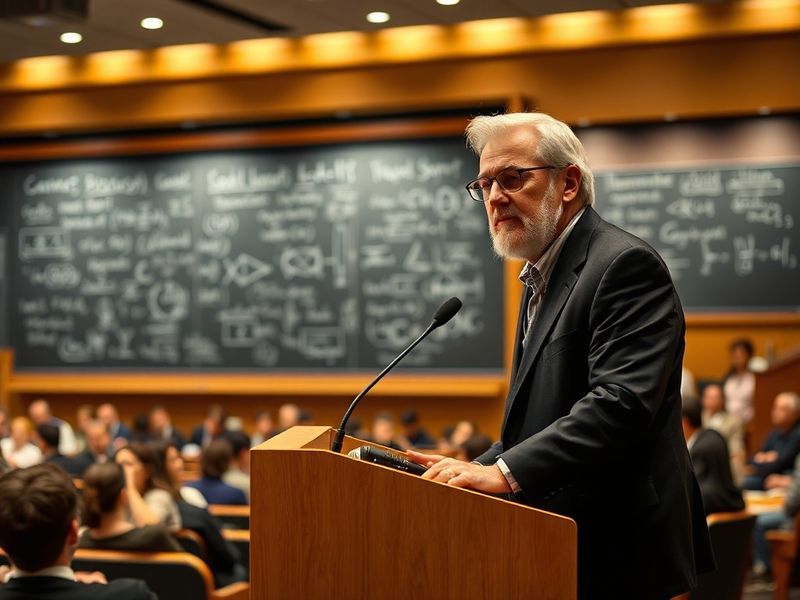
David Gross: How One Physicist Changed Our Understanding of the Universe
“`html
David Gross: The Physicist Who Redefined Quantum Fields
David Gross stands as one of the most influential theoretical physicists of the past half-century. His work reshaped our understanding of the fundamental forces governing the universe, particularly in quantum chromodynamics (QCD) and string theory. With a career spanning over five decades, Gross has not only contributed groundbreaking theories but has also shaped the next generation of physicists through mentorship and leadership.
The Nobel Prize and the Birth of Quantum Chromodynamics
In 2004, David Gross, along with David Politzer and Frank Wilczek, was awarded the Nobel Prize in Physics for their discovery of asymptotic freedom in the theory of the strong interaction. This groundbreaking work, completed in the early 1970s, provided the mathematical framework for quantum chromodynamics, the theory that describes how quarks and gluons interact within protons and neutrons.
Asymptotic freedom is the phenomenon where the strong force between quarks becomes weaker as the distance between them decreases. This counterintuitive behavior was the missing piece in understanding the confinement of quarks—why they are never observed in isolation. Gross and his colleagues demonstrated that the force-carrying particles, gluons, carry a property called color charge, which leads to the counterintuitive weakening of the force at small distances. Their work provided the first consistent explanation for the behavior of quarks and gluons, cementing QCD as the correct theory of the strong nuclear force.
This discovery was pivotal in unifying the fundamental forces. Before QCD, physicists struggled to explain why quarks were always bound together inside composite particles like protons and neutrons. Gross’s work, alongside the development of the Standard Model, provided a coherent picture of three of the four fundamental forces: electromagnetism, the weak nuclear force, and the strong nuclear force. It also laid the groundwork for future research in particle physics, including the search for a unified theory that might include gravity.
String Theory and the Quest for a Unified Theory
By the late 1980s, Gross had shifted his focus to string theory, a framework that seeks to reconcile quantum mechanics with general relativity. String theory posits that the fundamental constituents of the universe are not point-like particles but tiny, vibrating strings. These strings oscillate at different frequencies, giving rise to the various particles observed in nature. Gross became one of the leading proponents of string theory, particularly in its early formulations.
In the early 1990s, Gross and his collaborators made significant contributions to the development of heterotic string theory, a variant that combines the best features of bosonic and superstring theories. This work was instrumental in advancing the idea that string theory could provide a consistent quantum theory of gravity. Gross’s research during this period focused on the mathematical structures underlying string theory, including the role of symmetry and the dynamics of higher-dimensional spaces.
Gross’s work in string theory was not without controversy. At the time, many physicists were skeptical of string theory’s lack of experimental verification. However, Gross argued that the theory’s mathematical elegance and its potential to unify all fundamental forces made it worth pursuing. He emphasized that theoretical physics often progresses through unexpected discoveries, and string theory represented a bold leap into uncharted territory. His advocacy helped keep the field alive during periods when it faced criticism from both within and outside the physics community.
Leadership and Mentorship in Theoretical Physics
Beyond his research, David Gross has played a crucial role in shaping the future of theoretical physics through leadership and mentorship. In 1997, he became the director of the Kavli Institute for Theoretical Physics (KITP) at the University of California, Santa Barbara. Under his leadership, KITP became a global hub for theoretical physics, fostering collaboration and innovation among researchers from around the world.
Gross’s mentorship of young physicists has been equally impactful. He has supervised numerous graduate students and postdoctoral researchers, many of whom have gone on to make significant contributions to the field. His approach to mentorship combines rigorous intellectual challenge with unwavering support. He encourages his students to think independently and pursue bold ideas, even if they challenge conventional wisdom. This philosophy has produced a generation of physicists who are unafraid to explore unconventional paths.
Gross’s influence extends beyond academia. He has been a vocal advocate for science policy, emphasizing the importance of fundamental research in driving technological and societal progress. He has served on numerous advisory boards and committees, including the National Academy of Sciences and the American Physical Society. His insights have helped shape funding priorities and research directions at institutions worldwide.
The Legacy of David Gross and the Future of Physics
David Gross’s contributions to physics are immeasurable. His work on asymptotic freedom revolutionized our understanding of the strong force, while his advocacy for string theory has kept the dream of a unified theory alive. His leadership at KITP and his mentorship of young physicists have ensured that his influence will endure for generations. Yet, Gross remains humble about his achievements, often emphasizing the collaborative nature of scientific discovery.
Looking ahead, Gross continues to explore the frontiers of theoretical physics. One of his current interests is the study of the swampland, a concept that seeks to distinguish consistent low-energy theories from those that cannot be embedded in a full quantum theory of gravity. This work could provide critical insights into the viability of string theory and other approaches to unification.
Gross’s career is a testament to the power of theoretical physics to uncover the deepest secrets of the universe. From his groundbreaking work on QCD to his advocacy for string theory, he has consistently pushed the boundaries of what is known and what is possible. His legacy is not only in the equations he has written but in the minds he has inspired.
For those interested in exploring more about the intersection of physics and cutting-edge research, consider visiting our Science and Education category pages on Dave’s Locker, where we dive deeper into the people and ideas shaping the future of discovery.
Key Contributions of David Gross
- Asymptotic Freedom: Discovered the phenomenon where the strong force weakens at smaller distances, explaining quark confinement.
- Quantum Chromodynamics (QCD): Provided the theoretical framework for the strong nuclear force, a cornerstone of the Standard Model.
- String Theory: Advanced the development of heterotic string theory and advocated for its potential to unify all fundamental forces.
- Leadership: Directed the Kavli Institute for Theoretical Physics, fostering collaboration and innovation in theoretical physics.
- Mentorship: Guided numerous young physicists who have gone on to make significant contributions to the field.