SpaceX Falcon Heavy Launch: What It Means for Spaceflight in 2024
“`html
SpaceX Falcon Heavy Launch: A New Era in Space Exploration
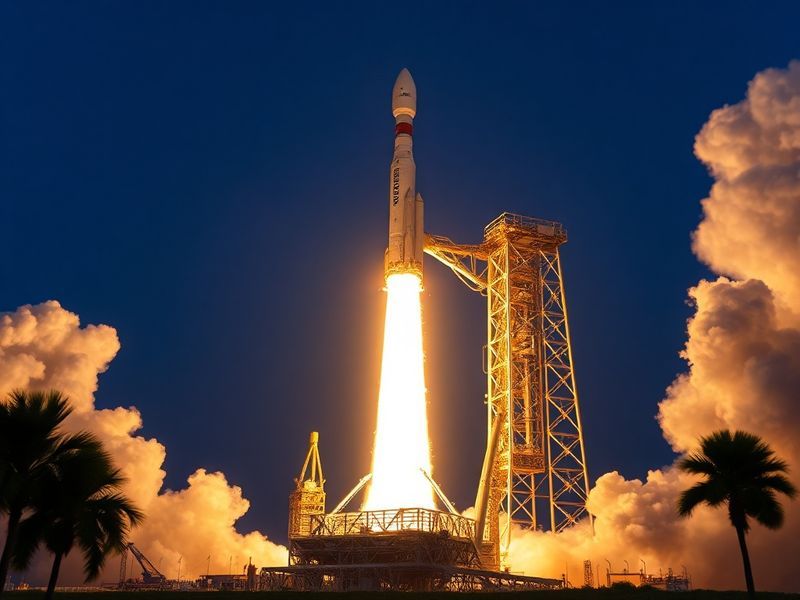
SpaceX’s Falcon Heavy rocket has redefined what’s possible in spaceflight since its groundbreaking debut. The most powerful operational rocket in the world, it combines raw power with reusable technology to slash the cost of reaching orbit. Beyond its technical achievements, the Falcon Heavy represents a shift in how humanity approaches space exploration, commercial ventures, and even interplanetary ambitions.
The Origins and Evolution of the Falcon Heavy
Elon Musk first unveiled plans for the Falcon Heavy in 2011, promising a rocket capable of lifting nearly 64 metric tons to low Earth orbit—twice the payload of its closest competitor at the time. The design leveraged three Falcon 9 first-stage boosters, strapped together to create a single, colossal launch vehicle. This strategy allowed SpaceX to reuse existing technology, reducing development costs and accelerating the timeline.
The rocket’s maiden flight on February 6, 2018, was nothing short of spectacular. Against the odds, SpaceX successfully launched the Falcon Heavy, sending Musk’s personal Tesla Roadster—complete with a mannequin dubbed “Starman”—into an Earth-Mars elliptical orbit. The event drew over 2.3 million concurrent viewers on YouTube, making it one of the most-watched rocket launches in history. More importantly, it proved that a private company could build and operate a super-heavy-lift launch vehicle.
Technical Breakthroughs and Reusability
The Falcon Heavy’s design is built on three core innovations: clustered boosters, synchronized landings, and rapid reusability. Each of the 27 Merlin engines in the first stage generates over 230,000 pounds of thrust, creating a combined force of nearly 5.1 million pounds at liftoff. This immense power enables the rocket to carry payloads far larger than any other currently flying commercial rocket.
Perhaps even more impressive is the rocket’s ability to return its boosters to Earth for reuse. During its first mission, two side boosters landed simultaneously at Cape Canaveral, while the center core attempted a landing on a drone ship in the Atlantic. Though the center core missed its target and crashed into the ocean, subsequent missions have refined the process. SpaceX now routinely recovers all three boosters, significantly cutting launch costs and increasing operational efficiency.
- Clustered Boosters: Three Falcon 9 cores combined to triple thrust and payload capacity.
- Synchronized Landings: Side boosters land in unison, a visual spectacle and logistical milestone.
- Reusable Design: Each booster is refurbished and reflown, reducing costs by up to 70% per launch.
- High Payload Capacity: Can lift 64 metric tons to low Earth orbit, rivaling NASA’s Saturn V in raw power.
The economic implications are profound. Traditional launch providers charge between $10,000 and $20,000 per kilogram to reach orbit. SpaceX’s reusable system has driven that cost down to as low as $1,500 per kilogram, making space more accessible to governments, startups, and research institutions. This price revolution has opened the door to new industries, from satellite mega-constellations to lunar tourism and even Mars missions.
Broader Implications for Space Exploration
The Falcon Heavy is more than a rocket—it’s a catalyst for change across the entire space sector. Its success has forced governments and competitors to rethink their strategies. NASA, for instance, pivoted from developing its own heavy-lift rocket (the Space Launch System) to partnering with SpaceX on lunar and Mars missions. The agency now relies on the Falcon Heavy for critical payloads, including the Psyche mission to a metal-rich asteroid and the upcoming Gateway lunar outpost components.
Commercially, the rocket has enabled a wave of innovation. Companies like ViaSat, Arabsat, and the U.S. Air Force have used it to deploy massive communications satellites into geostationary orbit. Meanwhile, startups such as Astrobotic and Intuitive Machines have booked rides to the Moon, leveraging the Falcon Heavy’s power to deliver lunar landers as part of NASA’s Commercial Lunar Payload Services program.
Beyond Earth, the Falcon Heavy plays a role in humanity’s expansion into the solar system. While not powerful enough for crewed Mars missions on its own, it serves as a stepping stone. The rocket’s upper stage, combined with future in-space refueling, could enable cargo missions to Mars as early as the late 2020s. This aligns with Musk’s long-term vision of establishing a self-sustaining city on the Red Planet—a goal that once seemed like science fiction.
Challenges and the Road Ahead
Despite its achievements, the Falcon Heavy faces competition and limitations. SpaceX’s own Starship, currently in development, promises even greater payload capacity and full reusability at a lower cost. If Starship succeeds, the Falcon Heavy may eventually be phased out, serving as a transitional technology rather than a permanent fixture.
Additionally, the rocket’s launch cadence remains relatively low. While SpaceX has flown the Falcon Heavy multiple times since 2018, its missions are spaced months apart, often delayed by payload readiness or technical hurdles. This contrasts with the rapid launch tempo of the Falcon 9, which flies weekly. To maximize its potential, the Falcon Heavy needs a steady stream of customers—government contracts, commercial satellites, and perhaps even space tourism.
Environmental concerns have also surfaced. Each Falcon Heavy launch consumes thousands of gallons of rocket-grade kerosene (RP-1) and liquid oxygen, producing carbon dioxide and soot in the upper atmosphere. While the impact is localized and temporary, critics argue that the growing frequency of space launches could contribute to atmospheric changes over time. SpaceX has responded by developing more efficient engines and exploring methane-based fuels for future vehicles.
A Lasting Legacy
Regardless of its eventual fate, the Falcon Heavy has already cemented its place in history. It proved that private enterprise could outpace government-led programs in innovation and cost-efficiency. It reignited public fascination with spaceflight, inspiring a new generation of engineers and dreamers. And perhaps most importantly, it demonstrated that the final frontier is not just the domain of nations—it’s a place where companies, scientists, and entrepreneurs can shape the future.
As SpaceX continues to push boundaries with Starship and other ventures, the Falcon Heavy serves as a reminder of what’s possible when ambition meets engineering. It’s a rocket that didn’t just launch payloads—it launched a new era of spaceflight.
For those eager to follow the next chapter in space exploration, keep an eye on Dave’s Locker Science section, where we track the latest developments in aerospace and astrophysics. For deeper dives into commercial space ventures, visit our Technology category, where innovation and industry intersect.
One thing is certain: the sky is no longer the limit.