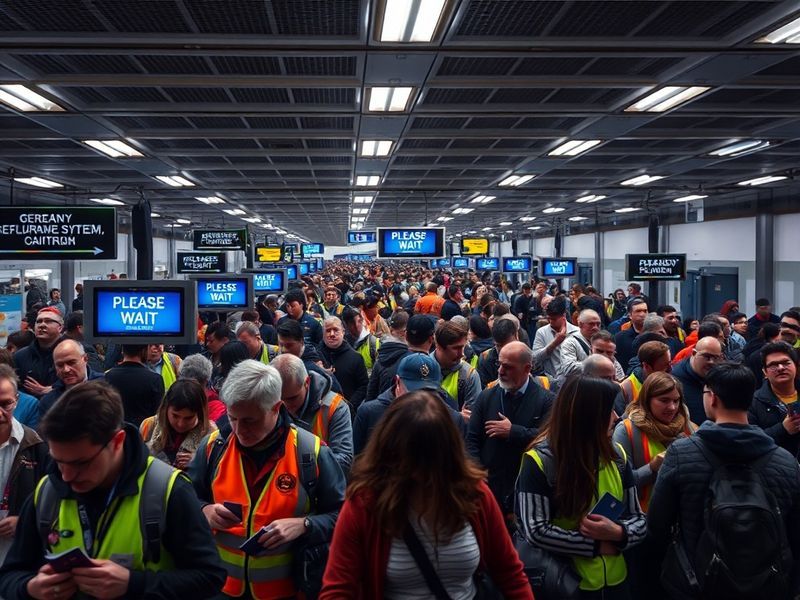
EU Entry/Exit System Faces Growing Pains as Travelers Adapt
The European Union’s Entry/Exit System (EES), designed to modernize border controls by replacing manual passport stamps with automated digital tracking, has encountered significant delays since its partial rollout in late 2023. While intended to streamline cross-border travel for the bloc’s 27 member states, the system’s slow integration has left travelers frustrated, airlines scrambling, and border agencies overstretched. As summer travel season approaches, the EES’s rocky implementation highlights the challenges of balancing technological innovation with real-world logistics.
Officially launched as part of the EU’s broader digital transformation of Schengen Area borders, the EES was meant to enhance security by recording entries and exits of non-EU nationals. The system aims to reduce identity fraud, track overstays, and improve the efficiency of border checks. Yet, technical glitches, understaffed deployment teams, and inconsistent training have resulted in long queues at major hubs like Paris Charles de Gaulle, Amsterdam Schiphol, and Frankfurt airports. Travelers from the United States, Canada, and other visa-exempt countries now face unexpected wait times, sometimes exceeding two hours.
The Human Cost of Digital Border Control
The delays are more than an inconvenience—they disrupt itineraries, strain family reunions, and erode confidence in the EU’s ability to manage its borders effectively. Families arriving to visit relatives in Spain or Italy have reported missing connecting flights after waiting in EES kiosk lines. Business travelers, already navigating post-pandemic recovery, now face additional uncertainty. “I’ve missed three meetings in the last month because of EES delays,” said Clara Mendez, a Madrid-based consultant. “The system is supposed to help, but for now, it’s just making things harder.”
Cultural tourism, a vital sector for Southern European countries like Greece and Portugal, is also feeling the pinch. Smaller airports, less equipped to handle technical hiccups, have seen a sharp drop in last-minute arrivals. Local businesses that rely on tourist spending are voicing concerns over potential revenue losses. In Santorini, hotel owners report a 15% dip in early-season bookings compared to 2023, though officials attribute part of this to broader economic factors.
Technical Hurdles and Uneven Rollout
The EES was originally scheduled for full deployment in 2022 but faced repeated postponements due to software bugs and data privacy concerns. When limited trials began in October 2023, they were confined to seven airports and three ports. By April 2024, the system had expanded to 20 airports and several land borders, but inconsistencies remain. Some travelers bypass EES kiosks entirely, while others are rerouted multiple times due to system crashes.
Security experts note that the EES’s core functionality—recording biometric data such as fingerprints and facial images—is sound in theory. However, integration with national databases has proven problematic. “Member states use different systems for identity verification,” explained Dr. Elena Petrov of the Center for European Policy Studies. “When the EES tries to sync with a database that wasn’t built for real-time updates, you get bottlenecks.”
To mitigate the chaos, several EU countries have temporarily relaxed enforcement. France, for example, has extended grace periods for travelers who arrived during EES outages without proper registration. But such stopgaps are unsustainable as the system scales up. The European Commission has acknowledged the “teething issues” but insists that full functionality will be achieved by the end of 2024.
Global Implications and Lessons for Other Regions
The EES delays aren’t unique. Similar automated border systems in the United States (via the CBP’s Automated Passport Control) and Australia (SmartGate) have faced their own technical and operational challenges. Yet the EU’s experience stands out due to the scale of its ambition: managing 400 million annual non-EU arrivals across 27 countries. The bloc’s reliance on consensus-driven policy-making means that even minor technical flaws can ripple across the entire system.
International travelers are growing increasingly vocal. Online forums and social media are filled with anecdotes of missed flights and lost luggage, often tagged with #EESStress or #SchengenStruggle. Some have begun rerouting trips through non-Schengen hubs like London or Istanbul to avoid the delays. Airlines, caught in the middle, have urged passengers to arrive three hours before departure—a recommendation that contradicts the EU’s own guidance of two hours.
Despite the setbacks, there’s cautious optimism that the EES will eventually deliver on its promise. A 2023 study by the European Travel Commission found that 78% of travelers support digital border systems in principle, despite current frustrations. The key, analysts say, lies in better coordination between member states and clearer communication with the public.
What’s Next for EES and Travelers?
The European Commission has outlined a phased expansion of the EES, with full coverage expected by late 2024. In the meantime, travelers can take several steps to reduce delays:
- Pre-register biometric data online through the EU’s dedicated portal before arrival.
- Download the EU Entry/Exit app for real-time updates on kiosk availability.
- Carry printed copies of travel itineraries and accommodation details, as border guards may request them.
- Avoid peak travel hours, especially on weekends and holidays.
For those planning trips to the Schengen Zone this summer, patience and preparation will be essential. While the EES represents a necessary evolution in border management, its current flaws serve as a reminder that even the most advanced systems require human oversight and continuous refinement.
As Clara Mendez, the consultant from Madrid, put it: “We all want safer, faster travel. But we also need a system that works on the ground, not just on paper.”
For more travel insights and border updates, visit our Travel and News sections.