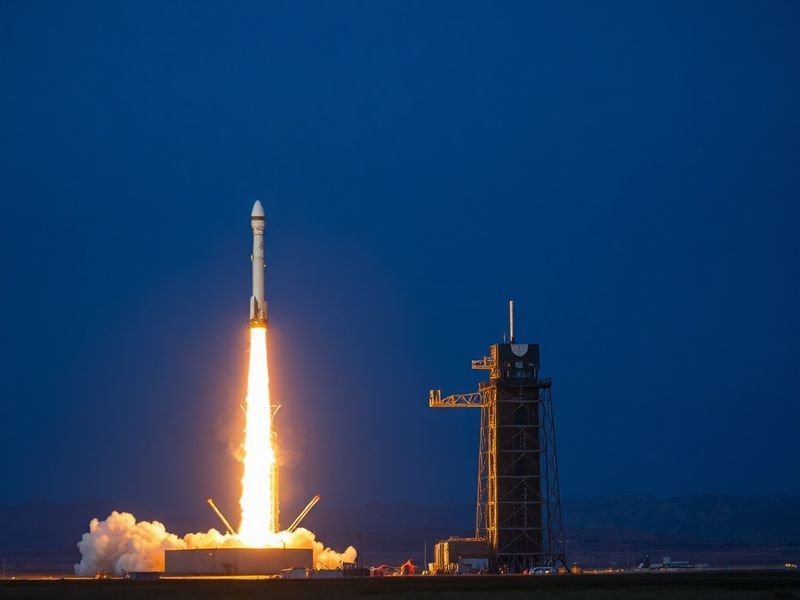
SpaceX successfully launched another batch of Starlink satellites from Vandenberg Space Force Base in California on the evening of October 12, 2023. This mission, designated Starlink Group 7-4, carried 21 second-generation satellites into low Earth orbit, marking another incremental step in the company’s ambitious plan to create a global broadband network. The launch occurred at 7:43 p.m. PDT, lifting off from Space Launch Complex 4 East (SLC-4E) aboard a Falcon 9 rocket.
The first stage booster, tail number B1071, completed its seventh flight, landing safely on the drone ship Of Course I Still Love You stationed in the Pacific Ocean. This booster has previously supported missions including the NROL-87 and NROL-88 reconnaissance satellite launches, as well as multiple Starlink deployments. The reuse of flight-proven hardware continues to demonstrate SpaceX’s commitment to cost reduction and operational efficiency in spaceflight.
Technical Breakdown of the Mission
The Starlink Group 7-4 launch was notable for several technical reasons. The payload consisted entirely of V2 Mini satellites, a scaled-down version of the full V2 satellites designed to fit on the Falcon 9 rocket. These satellites feature improved phased-array antennas and more powerful onboard processing, which enhance their ability to deliver high-speed, low-latency internet services.
The mission profile followed a typical Starlink launch sequence. After liftoff, the Falcon 9 ascended through the atmosphere, with stage separation occurring approximately two and a half minutes into flight. The second stage then ignited its single Merlin Vacuum engine to carry the payload into a preliminary orbit. The satellites were deployed in a circular orbit at an altitude of about 530 kilometers and an inclination of 53 degrees.
SpaceX confirmed successful deployment of all satellites roughly 15 minutes after launch. Over the coming weeks, the satellites will use their onboard ion thrusters to raise their orbits to the operational altitude of 540 kilometers and enter service as part of the existing constellation.
Launch Site Significance: Why Vandenberg Matters
Vandenberg Space Force Base has become a critical launch site for SpaceX, particularly for polar and high-inclination orbits. Located on California’s central coast, the base offers unique geographic advantages. Unlike Cape Canaveral in Florida, which primarily supports launches to the east over the Atlantic, Vandenberg allows rockets to fly south over the Pacific, avoiding populated areas and enabling access to orbits that pass over Earth’s poles.
This capability is especially important for Earth observation and climate monitoring satellites, as well as Starlink missions targeting global coverage. The base’s infrastructure has been significantly upgraded in recent years to support increased launch cadence, including expanded payload processing facilities and enhanced range safety systems.
Since 2019, SpaceX has conducted over 30 launches from Vandenberg, including commercial, government, and Starlink missions. The base’s proximity to the Pacific Ocean also facilitates rapid recovery operations for first-stage boosters, reducing the time and cost associated with returning hardware to port.
Expanding the Starlink Constellation: What’s Next for Global Internet
The Starlink program remains one of SpaceX’s most visible and rapidly evolving initiatives. As of October 2023, the constellation includes over 4,800 operational satellites, with thousands more planned. The company has secured regulatory approval to operate up to 12,000 satellites in low Earth orbit, with a long-term goal of expanding to 42,000.
Each new launch contributes to broader coverage and improved service quality. Starlink currently provides high-speed internet access to over 60 countries, with a strong presence in rural and underserved regions. The service has gained particular traction in areas where traditional broadband infrastructure is limited or cost-prohibitive.
However, the rapid expansion has raised concerns among astronomers and space sustainability advocates. The brightness of Starlink satellites has been shown to interfere with ground-based astronomical observations, prompting SpaceX to develop and deploy anti-reflective coatings and other mitigation measures. The company continues to work with the scientific community to minimize the impact of its constellation on the night sky.
Regulatory and Competitive Landscape
SpaceX is not alone in pursuing global broadband from space. Competitors such as OneWeb, Amazon’s Project Kuiper, and China’s Guowang constellation are also racing to deploy thousands of satellites. Regulatory bodies such as the Federal Communications Commission (FCC) in the United States and the International Telecommunication Union (ITU) play a crucial role in allocating orbital slots and spectrum resources.
Starlink has already secured a significant first-mover advantage, with a robust user base and proven service. However, the competitive landscape is intensifying. OneWeb, backed by the UK government and Bharti Global, has launched over 600 satellites and aims to offer global coverage by 2024. Project Kuiper, Amazon’s response to Starlink, plans to deploy 3,236 satellites and has secured launch contracts with both SpaceX and United Launch Alliance.
In the U.S., the FCC has approved SpaceX’s request to operate up to 7,500 additional satellites in the 540–570 km altitude range, further solidifying its position. The agency has also emphasized the importance of spectrum sharing and interference mitigation to ensure coexistence with other satellite operators and terrestrial networks.
Looking Ahead: The Future of Space-Based Internet
The success of the Starlink Group 7-4 launch underscores the growing role of commercial spaceflight in shaping the future of global connectivity. As SpaceX continues to refine its launch operations and satellite technology, the potential for space-based internet to bridge the digital divide becomes increasingly tangible.
Looking forward, several key developments are on the horizon:
- Expanded Coverage: SpaceX has announced plans to extend Starlink service to mobile platforms, including maritime and aviation customers, starting in 2024.
- Direct-to-Cell Service: The company is developing technology to enable direct communication between Starlink satellites and standard smartphones, potentially revolutionizing mobile connectivity in remote areas.
- Regulatory Challenges: As more players enter the market, pressure on regulatory bodies to streamline licensing and address spectrum allocation will grow.
- Sustainability Initiatives: SpaceX is investing in satellite end-of-life deorbiting strategies and debris mitigation to address concerns about orbital congestion and space sustainability.
For now, the focus remains on execution. The October 12 launch from Vandenberg was a textbook mission, demonstrating SpaceX’s ability to reliably deploy satellites at scale. Each successful flight brings the company closer to its vision of a truly global internet—one that is fast, affordable, and accessible to all.
The broader implications extend beyond connectivity. Space-based internet has the potential to empower education, healthcare, and economic development in regions that have long been left behind by terrestrial infrastructure. It also represents a new frontier in the commercialization of space, with far-reaching consequences for geopolitics, technology, and society.
As SpaceX continues to push the boundaries of what’s possible in spaceflight, the world watches closely. The next launch from Vandenberg—or from any of the company’s launch sites—could be the one that finally delivers on the promise of a fully connected planet.
For more on commercial spaceflight and satellite technology, visit our Technology category. To learn about the broader impact of satellite internet, explore our Science section.