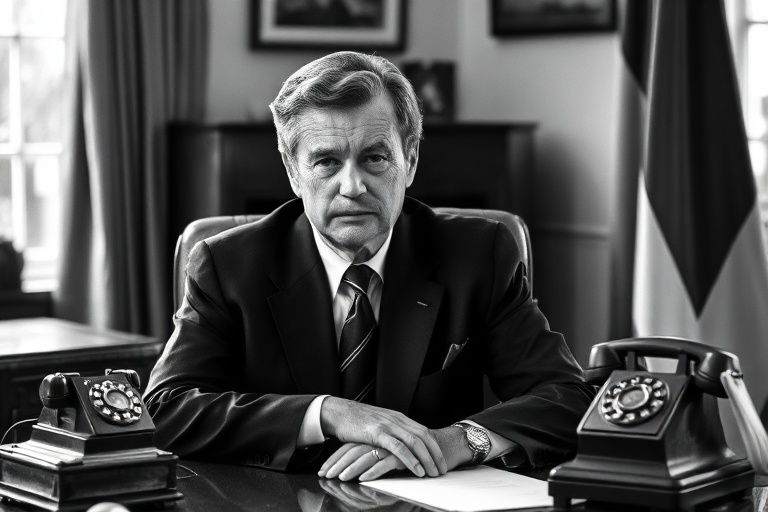
Gerhard Schröder remains one of Germany’s most polarizing political figures, a chancellor whose tenure reshaped the country’s domestic and international landscape. Serving from 1998 to 2005, Schröder’s leadership was marked by bold reforms, economic challenges, and later, a controversial pivot into the private sector that drew global scrutiny. His legacy is a tapestry of progressive policies and ethical quandaries, leaving an indelible mark on German politics.
The Rise of a Social Democrat
Born in 1944 in Mossenberg-Wöhren, a small town in North Rhine-Westphalia, Schröder’s early life was shaped by working-class struggles. His father died in World War II, and his mother worked as a farm laborer, instilling in him a deep connection to the struggles of ordinary Germans. After training as a retail salesman, Schröder eventually pursued higher education, studying law at the University of Göttingen. His political awakening came during the student protests of the late 1960s, where he became involved in the Social Democratic Party (SPD).
Schröder’s political career gained momentum in the 1980s as he rose through the ranks of the SPD in Lower Saxony. His pragmatic approach and charismatic leadership style set him apart from traditional party members. By 1990, he became the youngest state premier in Germany when he was elected to lead Lower Saxony. His tenure there was defined by a mix of economic pragmatism and social welfare policies, foreshadowing the balancing act he would later bring to the national stage.
Chancellor Schröder and the Agenda 2010 Reforms
Schröder’s most defining moment came in 1998 when he led the SPD to victory in the federal election, ending 16 years of Christian Democratic Union (CDU) rule. His victory was fueled by promises of economic renewal and social justice, but the challenges he inherited were formidable. Germany was grappling with high unemployment, sluggish growth, and the financial burdens of reunification. To address these issues, Schröder introduced Agenda 2010, a sweeping set of labor market and welfare reforms designed to modernize the German economy.
The reforms, implemented between 2003 and 2005, included cuts to unemployment benefits, deregulation of labor markets, and incentives for companies to hire. Proponents argued that Agenda 2010 was necessary to restore Germany’s global competitiveness. Critics, however, condemned the measures as a betrayal of the SPD’s traditional values, leading to widespread protests and a split within the party. The reforms did eventually contribute to a reduction in unemployment, but the social costs—particularly the rise in poverty and inequality—remain subjects of debate.
Schröder’s leadership during this period was marked by a willingness to challenge the status quo, even at the expense of his party’s unity. His ability to navigate complex political landscapes earned him both admiration and criticism. Internationally, he positioned Germany as a leader in the European Union, advocating for closer integration and a stronger social dimension to globalization.
The Controversial Shift: Schröder and Russian Energy Deals
After leaving office in 2005, Schröder’s career took an unexpected turn when he joined the board of Rosneft, a Russian state-owned oil company, in 2017. This move followed years of close ties with Russian President Vladimir Putin, including the controversial approval of the Nord Stream 1 gas pipeline during his chancellorship. Critics accused Schröder of leveraging his political connections for personal gain, a charge he has consistently denied. The perception of a conflict of interest was further exacerbated by his vocal support for Putin’s policies, including Russia’s annexation of Crimea in 2014.
Schröder’s relationship with Putin has drawn international condemnation, particularly in the wake of Russia’s full-scale invasion of Ukraine in 2022. As European leaders severed ties with Moscow, Schröder faced increasing pressure to distance himself from the Kremlin. Despite calls for his resignation from positions linked to Russian energy projects, he has remained defiant, arguing that dialogue with Russia is essential for global stability. His stance has cemented his reputation as a controversial figure, admired by some for his diplomatic efforts and reviled by others for his perceived complicity.
Legacy and the Schröder Paradox
Gerhard Schröder’s legacy is a paradox of progressive achievements and ethical ambiguities. On one hand, his domestic policies, particularly Agenda 2010, are credited with revitalizing Germany’s economy and preparing the country for the challenges of globalization. His commitment to European integration and social democracy also left a lasting imprint on the continent’s political landscape. On the other hand, his post-political career and ties to authoritarian regimes have tarnished his reputation, raising questions about the boundaries between public service and private gain.
Schröder’s influence extends beyond Germany’s borders. His leadership during the early 2000s helped shape the EU’s approach to economic reform and social policy. His close relationship with Putin, however, has complicated his legacy, particularly as Europe grapples with the consequences of Russian aggression. For historians and political analysts, Schröder represents the complexities of modern leadership—a figure who balanced pragmatism with principle, often at a significant cost.
As Germany continues to navigate its role in an increasingly polarized world, Schröder’s career serves as a case study in the challenges of leadership. His story underscores the fine line between reform and retrenchment, between diplomacy and complicity. Whether viewed as a visionary or a villain, Schröder’s impact on German and European politics is undeniable.
Key Takeaways from Gerhard Schröder’s Career
To understand Schröder’s legacy, it’s helpful to break down the key phases of his career and their implications:
- Early Political Career: Schröder’s rise from a working-class background to the helm of Lower Saxony showcased his pragmatic leadership and ability to connect with voters. His tenure laid the groundwork for his national ambitions.
- Chancellorship and Agenda 2010: The reforms were a bold attempt to modernize Germany’s economy but came at a social cost, sparking widespread discontent and reshaping the political landscape.
- Post-Political Career and Ties to Russia: Schröder’s close relationship with Putin and his involvement in Russian energy projects have overshadowed his political achievements, fueling debates about ethics in public life.
- Legacy and Influence: Schröder’s career reflects the tensions between economic necessity and social justice, as well as the blurred lines between public service and private interests in modern politics.
For those interested in exploring more about German political history, the Politics section on Dave’s Locker offers further insights into the figures and events that have shaped the country’s trajectory. Similarly, the Europe category provides broader context on the continent’s evolving political landscape.
Conclusion: A Figure of Contradictions
Gerhard Schröder’s career is a study in contradictions. He was a Social Democrat who championed market-driven reforms, a German leader who cultivated close ties with an autocratic regime, and a statesman whose legacy is both celebrated and condemned. His story challenges easy categorization, reflecting the complexities of modern governance and the personal toll of political ambition.
As Germany and Europe confront new challenges—from economic uncertainty to geopolitical tensions—Schröder’s career offers valuable lessons. It highlights the importance of balancing reform with equity, diplomacy with principle, and personal ambition with public duty. Whether one views him as a reformer or a renegade, Schröder’s impact on German and European politics is undeniable, and his story continues to provoke debate and reflection.
For those seeking to understand the nuances of contemporary European politics, Schröder’s career provides a compelling case study. It reminds us that leadership is rarely black and white, and that the choices made by figures like Schröder can have far-reaching consequences for generations to come.