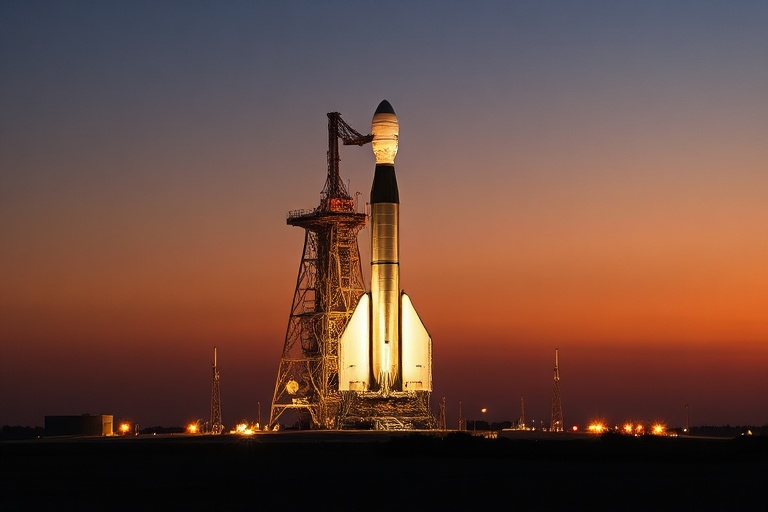
Starship: How SpaceX’s Giant Rocket Is Reshaping Space Travel
“`html
Starship: How SpaceX’s Giant Rocket Is Reshaping Space Travel
Elon Musk’s SpaceX has long been synonymous with ambitious goals, but none are as transformative as Starship. The fully reusable, super heavy-lift launch vehicle represents more than just another spacecraft—it’s a potential cornerstone for humanity’s future in space. With a payload capacity of up to 150 metric tons to low Earth orbit, Starship is designed to carry both crew and cargo, making it central to SpaceX’s vision of Mars colonization and interplanetary travel.
What sets Starship apart is its scale and reusability. Unlike traditional rockets that are discarded after a single use, Starship and its Super Heavy booster are engineered to land back on Earth and fly again. This approach aims to slash the cost of space travel, potentially reducing the price of a single launch to as little as $2 million—a fraction of what current systems cost. The implications reach beyond Mars missions, touching commercial satellite deployment, lunar exploration, and even rapid Earth-to-Earth transportation.
The Design and Capabilities of Starship
Starship is a two-stage system composed of the Starship spacecraft and the Super Heavy rocket. The Super Heavy booster stands at 230 feet tall and is powered by 33 Raptor engines, generating over 16 million pounds of thrust at liftoff. The Starship spacecraft itself is 164 feet tall and can carry up to 100 people, equipped with life support systems, storage, and even private cabins for long-duration missions.
One of Starship’s most innovative features is its stainless-steel construction. Unlike traditional aluminum-lithium alloys, stainless steel offers durability at extreme temperatures, reducing the need for extensive refurbishment between flights. The rocket also uses a unique ” belly-flop” reentry maneuver, where it transitions from horizontal to vertical for landing—a technique that has been tested and refined through multiple prototypes, including the explosive early flights of Starship SN8 and SN9.
Another key innovation is in-space refueling. Starship is designed to dock with tanker versions in Earth orbit, allowing it to receive propellant for longer missions. This capability is essential for trips to the Moon and Mars, where carrying all the fuel needed from Earth would be impractical. NASA has already selected a modified version of Starship, called the Human Landing System, to return astronauts to the lunar surface as part of the Artemis program.
Why Starship Matters Beyond Mars
The impact of Starship extends far beyond the dream of colonizing Mars. On a commercial level, it could revolutionize satellite launches. The rocket’s massive payload capacity means it can deploy entire constellations of satellites in a single launch, drastically reducing deployment costs for companies like Starlink, which aims to provide global broadband internet. This could accelerate the growth of the space economy, which is projected to reach over $1 trillion by 2040.
In the realm of science and exploration, Starship opens new possibilities. NASA’s Artemis program plans to use Starship to land the first woman and the next man on the Moon by 2026. The rocket’s ability to carry large payloads also makes it ideal for delivering habitats, rovers, and scientific instruments to the lunar surface. Longer term, Starship could support the construction of a permanent lunar base, serving as a stepping stone for deeper space exploration.
Beyond the Moon and Mars, Starship has been proposed for ambitious missions such as deflecting asteroids, repairing satellites in orbit, and even serving as a mobile space station. SpaceX has also floated the idea of using Starship for point-to-point Earth travel, suggesting that a journey from New York to Tokyo could take less than an hour. While these concepts remain speculative, they highlight the transformative potential of the technology.
Challenges and Controversies
Despite its promise, Starship faces significant challenges. Development has been marked by high-profile test failures, including multiple prototypes that exploded during landing attempts. The Federal Aviation Administration (FAA) has imposed strict environmental reviews, delaying the first orbital test flight, which finally took place in April 2023. Although the flight ended with the rocket being intentionally destroyed, it provided valuable data and validated key aspects of the design.
Environmental concerns have also been raised. Starship’s Raptor engines burn methane and oxygen, producing carbon dioxide and water vapor. While these emissions are less harmful than those from traditional rocket fuels, the cumulative impact of frequent launches—especially if SpaceX scales up operations—remains a subject of debate among scientists. Additionally, the noise and vibration from launches have sparked local opposition near SpaceX’s Starbase facility in South Texas.
There are also questions about safety and reliability. Starship’s ambitious design pushes the boundaries of current engineering, and any failure during crewed missions could have catastrophic consequences. SpaceX has emphasized redundancy and rapid iteration, but the risks are inherent in such a groundbreaking project.
What’s Next for Starship?
The next phase of Starship’s development will focus on achieving full reusability and reliability. SpaceX is preparing for another orbital test flight, with plans to refine the landing procedures and improve the robustness of the vehicle. The company has also begun testing the Starship upper stage in Earth orbit, a critical step toward demonstrating its ability to reach other celestial bodies.
For space enthusiasts, the coming years will be pivotal. If Starship proves successful, it could redefine how humans interact with space, making off-world living a tangible possibility. It could also inspire a new generation of engineers, scientists, and entrepreneurs to push the boundaries of what’s possible. As SpaceX continues to iterate and improve, the world watches closely—because Starship isn’t just a rocket. It’s a symbol of what’s next.
Key Takeaways About Starship
- Fully reusable design: Both the Starship spacecraft and Super Heavy booster are built to land and fly again, drastically reducing launch costs.
- Massive payload capacity: With the ability to carry up to 150 metric tons to low Earth orbit, Starship can deploy entire satellite constellations or transport large cargo to the Moon and Mars.
- In-space refueling: Starship’s design includes the capability to refuel in orbit, enabling longer missions without the need to carry all propellant from Earth.
- NASA’s Artemis program: A modified version of Starship has been selected to land astronauts on the Moon, marking a significant step for human space exploration.
- Potential for rapid Earth travel: SpaceX has proposed using Starship for point-to-point Earth transportation, with the potential to cut intercontinental travel times to under an hour.
Whether Starship fulfills its lofty ambitions remains to be seen. But one thing is clear: it has already pushed the boundaries of aerospace engineering and redefined what’s possible in space travel. For those watching closely, Starship isn’t just a rocket—it’s the future, taking shape one flight at a time.
For more on SpaceX and the broader implications of Starship, explore our Technology and Science sections, where we dive deeper into the innovations shaping our world and beyond.