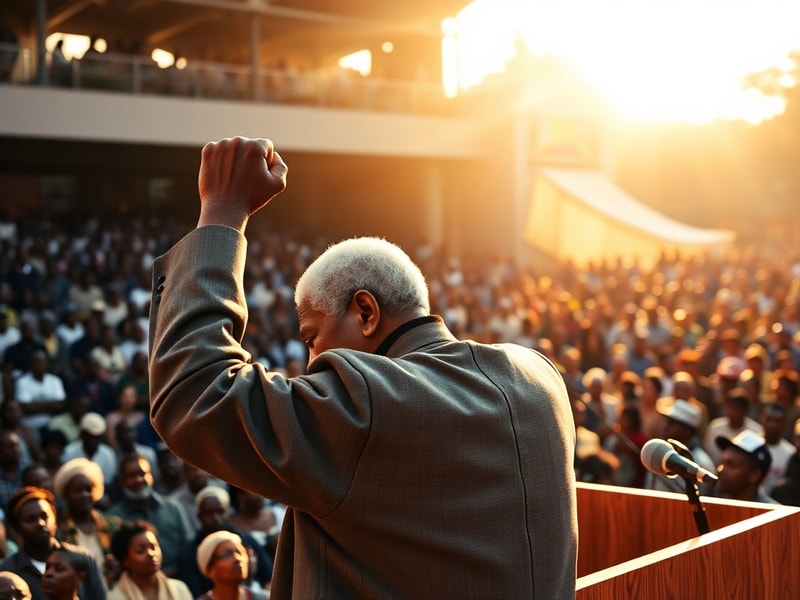
Nelson Mandela remains one of history’s most transformative figures—a man whose life bridged the gap between oppression and freedom, division and unity. His journey from prisoner to president reshaped not just South Africa but the global conversation on justice, reconciliation, and the power of forgiveness. Mandela’s legacy extends far beyond his political achievements; it challenges us to reconsider how societies confront their darkest chapters while building a shared future.
The Early Years: A Life Shaped by Injustice
Born in 1918 in the small village of Mvezo, Rolihlahla Mandela—who was later given the name Nelson by a schoolteacher—grew up in a world where racial inequality was codified into law. The son of a Thembu royal councilor, young Mandela was exposed early to the contradictions of apartheid, even before the system’s formal establishment in 1948. His involvement in student protests while attending Fort Hare University marked the beginning of his lifelong resistance to systemic oppression.
By the 1950s, Mandela had become a central figure in the African National Congress (ANC), advocating for nonviolent resistance against apartheid. His leadership during the 1952 Defiance Campaign and the drafting of the Freedom Charter solidified his reputation as a formidable organizer. Yet, as repression intensified, Mandela and his colleagues faced brutal crackdowns. The 1960 Sharpeville Massacre, where police killed 69 Black protesters, forced a reckoning. The ANC was banned, and Mandela was arrested in 1962, later sentenced to life imprisonment in the infamous Rivonia Trial.
Prison and the Birth of a Symbol
Mandela’s 27 years in prison—mostly on Robben Island—could have broken a lesser man. Instead, it forged his mythos. Isolated from the outside world, Mandela studied, strategized, and became a living symbol of resistance. His correspondence from prison, smuggled out in fragments, revealed a man committed to both principle and pragmatism. He rejected offers of conditional release, insisting that apartheid must end entirely before he would accept freedom. This unyielding stance turned him into a global icon, a beacon for those fighting tyranny.
The prison years also deepened Mandela’s understanding of the psychological toll of oppression. He later wrote in his autobiography, Long Walk to Freedom, that the true battle was not just against apartheid but for the soul of South Africa. His ability to see his jailers as potential allies, rather than irredeemable enemies, set the stage for his post-prison leadership.
The Presidency and the Art of Reconciliation
When Mandela walked free on February 11, 1990, the world watched as a nation teetered on the edge of civil war. Apartheid had entrenched racial divisions, and South Africa’s future hung in the balance. Against the advice of many, Mandela chose reconciliation over retribution. He negotiated with the apartheid government, formed a multiracial government, and prioritized national unity over punitive justice.
His presidency (1994–1999) was defined by three key initiatives:
- Truth and Reconciliation Commission (TRC): Established in 1995, the TRC allowed victims and perpetrators of apartheid-era crimes to share their stories in exchange for amnesty. It was a radical experiment in restorative justice, prioritizing healing over vengeance.
- Constitutional Democracy: Mandela oversaw the drafting of one of the world’s most progressive constitutions, enshrining equality, freedom of speech, and social justice.
- Economic Transformation: While he avoided wholesale land redistribution or nationalization, Mandela implemented policies to uplift Black South Africans through education and affirmative action, laying the groundwork for a more equitable economy.
Critics argue that Mandela’s conciliatory approach failed to address economic inequality adequately. The wealth gap between white and Black South Africans remains staggering, a testament to the limitations of his reconciliation model. Yet, the absence of widespread violence during South Africa’s transition is a testament to his vision.
Beyond South Africa: Mandela’s Global Influence
Mandela’s impact extended far beyond his homeland. He became a global ambassador for human rights, advocating for causes from HIV/AIDS awareness (after his son’s death from the disease) to sanctions against oppressive regimes. His 1993 Nobel Peace Prize, shared with F.W. de Klerk, underscored his role as a peacemaker.
Yet, Mandela’s legacy is not without controversy. Some activists critique his early ties to armed struggle, while others question whether his post-apartheid policies did enough to dismantle systemic racism. His relationship with figures like Libyan leader Muammar Gaddafi—whom he called a “brother” despite Gaddafi’s support for anti-apartheid groups—sparked debate about moral consistency.
Despite these complexities, Mandela’s life offers a blueprint for navigating entrenched conflict. His emphasis on dignity, dialogue, and incremental change remains relevant in an era where polarization often trumps compromise.
A Legacy That Demands Action
Mandela’s death in 2013 did not diminish his influence; if anything, it amplified the urgency of his message. Today, as democracies face rising authoritarianism and societies grapple with historical injustices, his example challenges us to ask: What does true reconciliation look like? How do we balance justice with unity?
South Africa continues to grapple with these questions. The ANC, once the vanguard of liberation, now faces criticism for corruption and failing to deliver on its promises. Yet, Mandela’s ideals endure in the Constitution, in the activism of movements like #FeesMustFall, and in the global fight for racial justice.
For those seeking to honor his legacy, the path forward is clear: It requires more than symbolic gestures. It demands structural change—economic justice, education reform, and a reckoning with the past. As Mandela once said, “Education is the most powerful weapon which you can use to change the world.” His words remind us that liberation is not a moment but a continuous struggle.
To understand Mandela is to recognize that freedom is not just the absence of chains but the presence of opportunity. His life urges us to build societies where dignity is not a privilege but a right.
Explore more on Politics and Culture for deeper analysis on global movements and historical figures.