Lincoln Memorial Reflecting Pool: History, Design, and Legacy
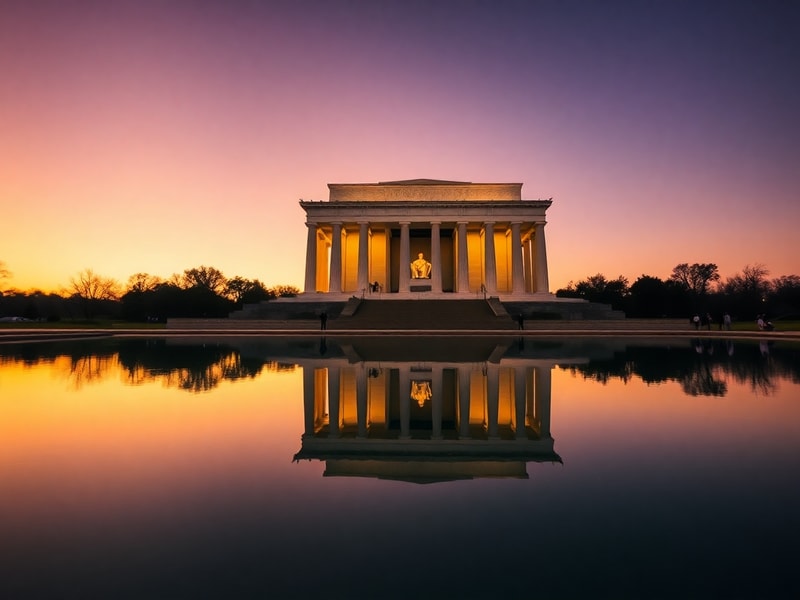
The Lincoln Memorial Reflecting Pool stands as one of Washington, D.C.’s most recognizable landmarks, stretching 2,029 feet between the Lincoln Memorial and the Washington Monument. Completed in 1923, the pool was designed by architect Henry Bacon as part of the larger National Mall renovation, intended to honor President Abraham Lincoln while creating a space for national reflection. Its long, rectangular basin spans nearly 1,000 feet in length and holds approximately 6.75 million gallons of water, making it one of the largest human-made bodies of water in the capital.
At first glance, the Reflecting Pool appears to be a simple, symmetrical feature—a long mirror framed by neoclassical architecture. Yet its significance runs deeper than aesthetics. The pool’s reflective surface creates a visual harmony between the Lincoln Memorial’s towering columns and the distant obelisk of the Washington Monument, reinforcing the axial design of the National Mall. It serves as more than a scenic element; it is a silent participant in the nation’s civic life, hosting moments of protest, remembrance, and national unity that have shaped American history.
The Design and Engineering Behind the Pool
Bacon’s design drew inspiration from classical Roman and Greek architecture, particularly the use of water as a unifying element in monumental spaces. The pool’s dimensions—618 feet long by 167 feet wide—were carefully calculated to complement the scale of the surrounding memorials. Its depth varies from 18 inches at the edges to 30 inches at the center, ensuring stability and ease of maintenance.
Constructed between 1914 and 1923, the pool required innovative engineering for its time. It was built using reinforced concrete lined with a waterproof membrane, a technique that was relatively new in large-scale public works. The water supply originally came from the Potomac River, filtered and pumped into the basin. Over the decades, the system has been updated to improve water quality and reduce algae growth, though periodic renovations have also sparked debate over preserving the original design intent.
One lesser-known detail is the pool’s subtle slope—just 1.5 inches over its entire length—designed to facilitate drainage without disrupting the mirror-like surface. This engineering choice reflects the meticulous planning behind one of the country’s most visited memorial sites, where even the smallest deviation could disrupt the intended visual effect.
Moments That Transformed the Reflecting Pool Into a Symbol
The Reflecting Pool has long served as a gathering place for civil rights leaders, activists, and citizens demanding change. Its most famous moment came during the 1963 March on Washington for Jobs and Freedom, where Martin Luther King Jr. delivered his “I Have a Dream” speech to a crowd of over 250,000 people. Standing on the steps of the Lincoln Memorial, King’s words echoed across the water, their resonance amplified by the open-air setting and the reflective surface that framed his figure against the monument.
Since then, the pool has been the site of countless demonstrations, vigils, and public gatherings. From anti-war protests in the 1960s to Black Lives Matter marches in 2020, the Reflecting Pool has consistently provided a powerful backdrop for civic expression. Its location—equidistant from the Capitol, White House, and Supreme Court—makes it a neutral, accessible space where diverse voices can be amplified.
Yet the pool’s role extends beyond activism. It has also been a stage for cultural moments, including concerts, memorial services, and even film shoots. Its appearance in movies like Forrest Gump and Independence Day cemented its place in the American visual imagination, transforming it from a civic space into a symbol of national identity.
The Pool’s Challenges: Maintenance, Controversy, and Climate Change
Despite its grandeur, the Reflecting Pool has faced persistent challenges. Algae blooms, sediment buildup, and water quality issues have required frequent cleaning and chemical treatments. In 2012, a $34 million renovation drained and refilled the pool, replacing its aging filtration system and restoring its original appearance. The project sparked discussions about balancing modernization with historic preservation, a debate that continues to shape the National Mall’s management.
Climate change poses another threat. Rising temperatures and heavier rainfall have increased the frequency of algae outbreaks, while extreme weather events—such as the derecho that struck D.C. in 2012—have damaged the pool’s infrastructure. The National Park Service has had to adapt, implementing more sustainable water management practices and exploring ways to reduce chemical use.
Controversy has also arisen over the pool’s role in public events. In 2021, the Park Service temporarily closed the pool to swimming due to safety concerns, reigniting debates about whether the Reflecting Pool should ever be used for recreational purposes. Some argue that its primary function as a memorial demands stricter preservation, while others believe it should remain a flexible space for public enjoyment.
These challenges highlight a broader tension in American civic spaces: How do we honor tradition while adapting to modern needs? The Reflecting Pool, once a symbol of permanence, now stands at the intersection of preservation and progress.
Why the Reflecting Pool Still Matters Today
The Lincoln Memorial Reflecting Pool remains a powerful reminder of the nation’s ideals—and its unfinished work. Its still waters mirror not just the monuments around it, but the faces of those who gather there to demand justice, celebrate progress, and reflect on history. In an era of digital activism and fragmented civic discourse, the pool offers a rare space for collective experience, where people from all walks of life come together under a shared sky.
Its endurance also speaks to the power of design. Unlike many modern structures that age poorly, the Reflecting Pool has only grown in symbolic weight over time. It bridges the gap between past and present, serving as both a tribute to Lincoln’s legacy and a stage for contemporary movements. In that sense, it is more than a pool—it is a living monument to democracy in action.
As Washington D.C. continues to evolve, the Reflecting Pool’s future will depend on finding a balance between preservation and adaptation. Whether through sustainable engineering, inclusive programming, or thoughtful public engagement, its next chapter must honor its legacy while ensuring it remains relevant for future generations.
For those who visit, the experience is often quiet but profound. Standing at the edge, the water ripples gently, reflecting not just the sky but the weight of history—and the promise of what comes next.
- Key facts about the Lincoln Memorial Reflecting Pool:
- Length: 2,029 feet (618 meters)
- Width: 167 feet (51 meters)
- Water capacity: Approximately 6.75 million gallons
- Construction completed: 1923
- Designer: Henry Bacon
- Notable events: 1963 March on Washington, 2020 Black Lives Matter protests
For more on the history of D.C. landmarks, explore our History section. To read about modern civic spaces and their evolving roles, visit our Culture category.