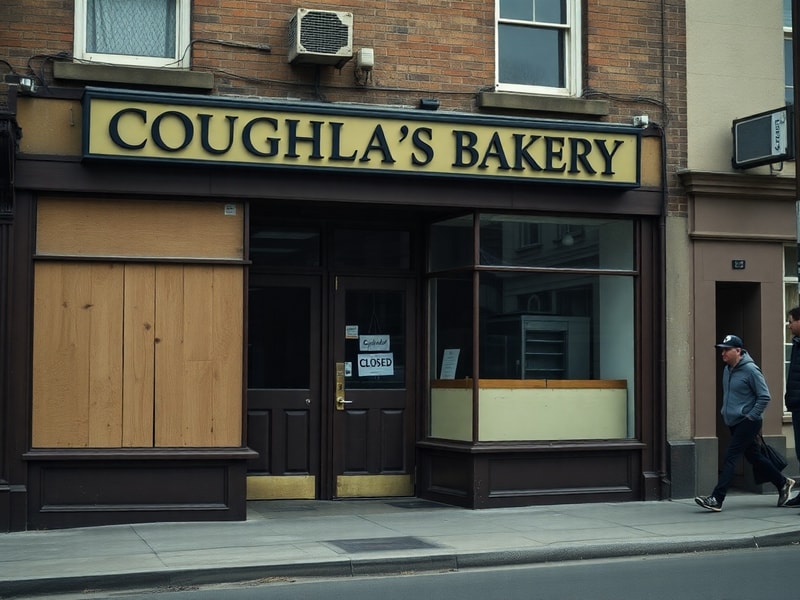
The Last Bite: What Coughlan’s Bakery Closure Means for a Changing Ireland
Coughlan’s Bakery, a name once synonymous with Irish morning rituals, has closed its doors after more than a century in business. The Cork-based institution, known for its soda bread, pastries, and hearty sandwiches, fell victim not to a single misstep but to the slow erosion of tradition by modern economics. Its closure is more than the end of a beloved bakery; it reflects broader shifts in how food is produced, distributed, and consumed across Europe and beyond.
Founded in 1919, Coughlan’s Bakery grew from a small family-run operation into a regional brand with a loyal following. For generations, Irish families relied on its products for breakfast tables and lunchtime treats. But over the past two decades, the bakery faced relentless pressure from large-scale industrial bakeries, supermarket chains, and changing consumer habits. The rise of frozen and pre-packaged bread, driven by convenience and lower costs, made it increasingly difficult for traditional bakeries to compete. Coughlan’s, despite its reputation for quality, could not sustain production costs or match the pricing of mass-produced alternatives.
This isn’t an isolated story. Across Europe, small bakeries are disappearing at an alarming rate. In France, the number of artisanal bakeries dropped by over 10% between 2010 and 2020. In Germany, more than 2,000 traditional bakeries closed in the same period. Even in Italy, the heartland of craft baking, industrial bread now accounts for 70% of supermarket shelves. The global trend is clear: tradition is being replaced by efficiency, authenticity by affordability, and local pride by corporate supply chains.
The consequences extend beyond nostalgia. The decline of local bakeries weakens community identity and erodes food sovereignty. When bread is produced thousands of miles away in automated factories, communities lose control over what they eat—and how it’s made. For Ireland, a country with a rich culinary heritage rooted in local grain and small-scale production, the loss of Coughlan’s is a cultural signal worth heeding.
A Generation of Disruption: Why Small Bakers Can’t Keep Up
The challenges facing traditional bakeries like Coughlan’s are structural and relentless. Rising energy and labor costs have squeezed profit margins, while ingredient prices fluctuate with global supply chains disrupted by war, climate change, and pandemics. Supermarkets, with their economies of scale, can sell sliced pan for less than €1—a price point no local bakery can match without sacrificing quality.
Consumer behavior has also shifted dramatically. Younger generations prioritize convenience over craftsmanship. The rise of “meal deals” in supermarkets, where pre-packaged sandwiches and snacks are sold at low prices, has normalized a transient approach to food. Why wait for fresh bread when you can microwave a loaf in 30 seconds? Why support a local baker when a global brand offers consistency and convenience?
Even tourism, once a lifeline for Irish food producers, has changed. Visitors today expect Instagram-ready experiences rather than the quiet reliability of a neighborhood bakery. Bakeries that once thrived on word-of-mouth now struggle to attract foot traffic in an era dominated by digital discovery and curated food destinations.
It’s not just about economics—it’s about culture. The closure of Coughlan’s reflects a broader erosion of everyday rituals. The morning visit to the baker, the chat with the shopkeeper, the smell of freshly baked bread—these are vanishing experiences in an increasingly transactional world. The loss is intangible but deeply felt, especially in smaller towns where such places serve as social hubs.
The Global Ripple: How Industrial Bread is Reshaping Diets Worldwide
Coughlan’s closure is a local tragedy with global echoes. The industrialization of bread production has transformed diets across the world, often with unintended health consequences. In the United States, the shift from artisanal to factory bread in the mid-20th century coincided with rising rates of gluten intolerance and digestive issues. While correlation doesn’t equal causation, research suggests that ultra-processed bread, stripped of fiber and nutrients, may contribute to modern dietary problems.
In India, the rise of packaged bread—often made with refined flour and preservatives—has led to a decline in traditional rotis and naans in urban areas. Similarly, in parts of Africa, imported wheat from Europe and North America has displaced local grains like millet and sorghum, undermining both nutrition and agricultural diversity. The global food system, while efficient, is not always aligned with human health or cultural integrity.
Even in countries where craft baking remains strong, such as Austria and Belgium, small bakeries are increasingly reliant on tourism and specialty markets. The pressure to conform to modern expectations—gluten-free options, vegan alternatives, organic certification—adds layers of complexity that many traditional bakers cannot afford to navigate.
This global shift raises important questions: Is the convenience of industrial bread worth the cultural and nutritional cost? Can small-scale bakeries survive in a world that values speed over soul? And what happens when entire communities lose their daily connection to fresh, locally made food?
Some communities are fighting back. In Ireland, initiatives like the Food and Drink Federation are advocating for policies to support small producers. In France, the “Boulangerie de France” label helps consumers identify authentic bakeries. And in cities like Berlin and Copenhagen, a resurgence of “craft bakeries” catering to niche markets shows that there is still demand for quality—if the price and accessibility are right.
Can Tradition Survive in a Fast-Food World?
The closure of Coughlan’s Bakery is a reminder that tradition, no matter how beloved, is not immune to economic forces. But it’s also a call to action. Supporting small bakeries isn’t just about nostalgia—it’s about preserving choice, fostering community, and maintaining a connection to the land and the people who feed us.
For consumers, the message is clear: vote with your wallet. Buy from local bakers when you can, even if it costs a little more. Ask questions about where your bread comes from. Support policies that level the playing field for small producers. For bakers, the path forward may lie in diversification—offering workshops, partnering with cafés, or embracing direct-to-consumer models online.
There’s a growing movement toward “slow food” and “local food” that values quality over quantity. In Ireland, organizations like Slow Food Dublin are reviving interest in traditional baking techniques and heritage grains. In the UK, the Real Bread Campaign advocates for better labeling and support for artisan bakers. These efforts are small but vital steps toward reclaiming food culture from the grip of industrialization.
Yet the odds remain steep. The global food system is dominated by a handful of corporations that prioritize profit over people, efficiency over craft. For every Coughlan’s that closes, another small bakery faces the same pressures. The question isn’t whether tradition will survive—it’s how much of it we’re willing to lose before we realize what’s at stake.
The last loaf from Coughlan’s may have been baked, but the story isn’t over. It’s a story about what we choose to preserve—and what we’re willing to let go.