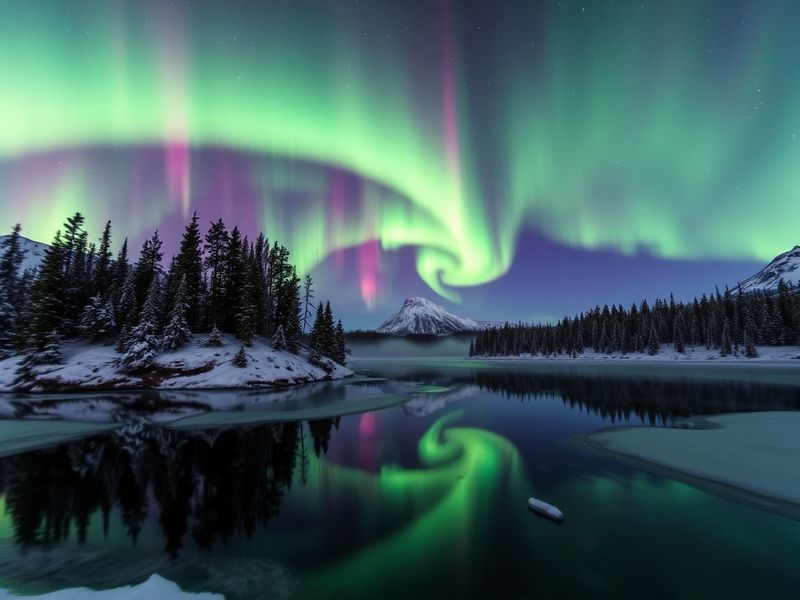
The aurora borealis, or northern lights, has captivated humanity for centuries. These celestial dances of green, pink, and purple light occur when charged particles from the sun collide with Earth’s atmosphere. While the phenomenon itself is awe-inspiring, predicting when and where it will appear requires sophisticated forecasting tools and scientific understanding.
How Aurora Forecasts Work
Modern aurora forecasting relies on a combination of space weather monitoring and atmospheric data analysis. The National Oceanic and Atmospheric Administration (NOAA) operates the Space Weather Prediction Center, which provides real-time aurora forecasts through its Aurora 30-Minute Forecast. This tool uses data from satellites monitoring solar wind conditions to predict auroral activity.
The Kp-index serves as the primary measurement for aurora visibility. This planetary index ranges from 0 (quiet) to 9 (extreme storm). For mid-latitude locations like southern Canada or northern United States, a Kp of 4 or higher is typically needed for visible auroras. In regions closer to the Arctic Circle, such as Alaska or northern Scandinavia, displays become visible at lower Kp values.
- Kp 0-3: Aurora typically visible only within the Arctic Circle
- Kp 4-5: Displays may extend to southern Canada and northern UK
- Kp 6-7: Auroras visible across northern US states and similar latitudes
- Kp 8-9: Major geomagnetic storms may bring auroras as far south as Texas or Florida
Best Locations and Times for Aurora Viewing
Geographic location plays a crucial role in aurora visibility. The phenomenon occurs in an oval-shaped ring around the magnetic poles, meaning proximity to these regions increases viewing opportunities. Popular destinations include:
- Tromsø, Norway: Known as the “Capital of the Arctic,” this city offers excellent infrastructure for aurora chasing with frequent clear skies
- Fairbanks, Alaska: Located under the auroral oval, Fairbanks averages more than 200 nights of visible auroras annually
- Yellowknife, Canada: Situated directly beneath the auroral zone, this remote location provides some of the best viewing conditions
- Abisko National Park, Sweden: The clear skies above this park create ideal viewing conditions despite its slightly lower latitude
- Dunedin, New Zealand: For those in the Southern Hemisphere, this location offers southern lights (aurora australis) viewing opportunities
Timing is equally important for successful aurora observation. The winter months from September to March provide the longest nights in the Northern Hemisphere, increasing viewing opportunities. Around the equinoxes (late September and March), increased solar activity often leads to more frequent auroral displays. The optimal viewing hours typically fall between 10 PM and 2 AM local time, though strong displays can persist for hours.
Tools and Resources for Tracking Auroras
Several websites and apps have become essential tools for aurora enthusiasts. The Geophysical Institute at the University of Alaska Fairbanks provides detailed forecasts specific to different Alaskan regions. For European viewers, the SpaceWeatherLive aurora forecast offers European-specific predictions.
Mobile applications have made aurora tracking more accessible than ever. Popular options include:
- My Aurora Forecast & Alerts: Provides real-time Kp-index readings and push notifications for upcoming displays
- Aurora Alerts: Uses data from NOAA and other sources to send location-based alerts
- Northern Lights Forecast: Offers cloud cover predictions alongside aurora forecasts for better planning
- Aurora Buddy: Specializes in aurora photography planning with exposure settings and timing recommendations
Webcams have also become valuable resources, particularly in popular aurora destinations. Many hotels and tourist centers in northern regions maintain live feeds that allow remote viewing of current conditions. These can be particularly useful when planning trips or checking conditions during cloudy periods.
Photographing the Aurora: Tips for Capturing the Display
Capturing the aurora on camera requires preparation and the right equipment. A digital SLR camera with manual settings works best, though modern smartphone cameras can produce impressive results with the proper technique. Essential equipment includes:
- A sturdy tripod to prevent camera shake during long exposures
- A wide-angle lens with a fast aperture (f/2.8 or wider) to capture more light
- Extra batteries (cold drains them quickly) and memory cards
- A remote shutter release or timer to minimize camera movement
Photography settings vary based on conditions, but a good starting point involves:
- ISO: 800-3200 (higher for faint displays, lower for bright ones)
- Aperture: Widest available (f/2.8 or lower)
- Shutter Speed: 10-20 seconds for still auroras, 5-10 seconds for moving displays
- Focus: Set to infinity or use manual focus on a bright star
Patience and persistence often determine the success of aurora photography. Display intensity can change rapidly, and what appears as a faint glow to the naked eye may reveal intricate structures in long-exposure photographs. Many photographers recommend bringing hand warmers for both personal comfort and camera maintenance in sub-zero temperatures.
The aurora forecast ecosystem has evolved significantly from the days when predictions relied solely on solar observations. Today’s sophisticated models incorporate data from multiple satellites, ground-based magnetometers, and atmospheric measurements to provide increasingly accurate forecasts. While no prediction can guarantee visible auroras, these tools have dramatically improved the odds of witnessing nature’s most spectacular light show.
For those planning aurora expeditions, combining forecast data with local weather predictions and cloud cover forecasts will maximize chances of success. The intersection of scientific prediction and natural wonder continues to draw travelers to the world’s northern regions, creating a unique blend of adventure and scientific curiosity that defines modern aurora chasing.