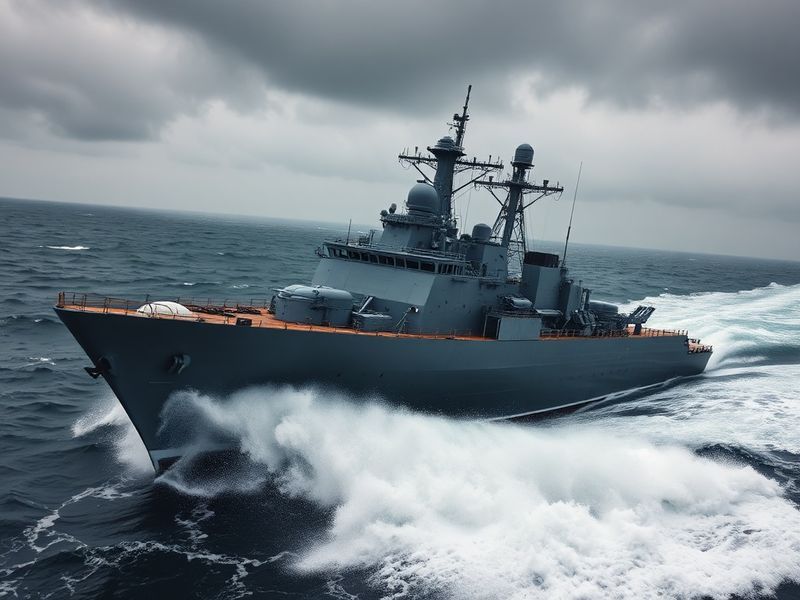
From Wooden Hulls to Nuclear Power: The Evolution of Warships
The warship has been a cornerstone of naval warfare for millennia, evolving from simple wooden vessels to the high-tech behemoths patrolling the world’s oceans today. These floating fortresses represent the pinnacle of maritime engineering, blending raw firepower with advanced technology to project power across vast distances. Their history is not just a story of technological progress but also of shifting global power dynamics, where control of the seas has often decided the fate of nations.
From the triremes of ancient Greece to the aircraft carriers of World War II, warships have shaped the course of history. Their design reflects the strategic priorities of their time—whether it was the Mediterranean dominance of the Roman Empire or the global reach of 19th-century colonial powers. Today, modern navies rely on warships that can operate independently for months, launch precision strikes, and even deploy drones, underscoring how far these vessels have come.
The Age of Sail and the Birth of Naval Superiority
Before the industrial revolution, warships were defined by their sails and cannons. The 16th and 17th centuries saw the rise of the galleon, a versatile vessel capable of long voyages while carrying heavy armament. Spain’s Man-of-War fleets dominated trade routes, enforcing colonial rule with fearsome broadside volleys. Meanwhile, the Dutch and later the British perfected the art of naval tactics, using formations like the line of battle to maximize firepower.
This era also introduced the concept of naval supremacy—the idea that controlling the seas was as important as controlling land. The Battle of Trafalgar in 1805, where Admiral Horatio Nelson’s British fleet defeated a combined Franco-Spanish force, cemented the Royal Navy’s dominance for over a century. Warships were no longer just tools of war; they became symbols of national prestige and economic power.
Steel, Steam, and the Modern Battleship
The 19th century brought two revolutions: ironclads and steam power. The American Civil War’s USS Monitor and CSS Virginia clashed in the first battle between iron-plated warships, proving that wooden hulls were obsolete. By the 1890s, battleships like Britain’s HMS Dreadnought redefined naval warfare with their all-big-gun armaments and steam turbine propulsion. These ships were floating arsenals, designed to engage in direct combat with enemy fleets.
The early 20th century saw the zenith of battleship design during World War I, where clashes like Jutland demonstrated their strategic value. However, the aircraft carrier’s emergence during World War II shifted the balance. The Japanese attack on Pearl Harbor in 1941 proved that battleships were vulnerable to air power, leading to their gradual decline. By the Cold War, the focus had shifted to missile-equipped cruisers and submarines, capable of striking from beyond visual range.
The Contemporary Warship: Stealth, Speed, and Silent Threats
Today’s warships are marvels of stealth and sophistication. The U.S. Navy’s Zumwalt-class destroyers, for example, feature angular designs and radar-absorbing materials to minimize detection. Meanwhile, China’s Type 055 cruisers boast advanced missile systems and integrated electronic warfare suites. These vessels are not just about firepower; they are designed to operate in contested environments, from the South China Sea to the Arctic.
Submarines remain one of the most critical components of modern naval strategy. Nuclear-powered boats like America’s Virginia-class can remain submerged for months, conducting intelligence gathering or delivering precision strikes. Their stealth capabilities make them nearly undetectable, a fact that has driven advancements in anti-submarine warfare, including sonar arrays and unmanned underwater vehicles.
Navies today face new challenges, from cyber threats to hypersonic missiles. The Arleigh Burke-class destroyers, the backbone of the U.S. fleet, are being upgraded with directed-energy weapons and AI-driven systems to counter these evolving threats. Meanwhile, smaller nations are investing in corvettes and fast-attack craft, which offer cost-effective ways to project power in regional conflicts.
The Cultural and Symbolic Weight of Warships
Beyond their military function, warships hold deep cultural significance. They appear in myths, literature, and film, often embodying national identity. The USS Missouri, where Japan surrendered in 1945, is now a museum ship, a reminder of both war’s end and its consequences. Similarly, Russia’s Admiral Kuznetsov aircraft carrier, despite its technical issues, remains a potent symbol of Moscow’s global ambitions.
Warships also play a role in diplomacy. Port visits and joint exercises, like those conducted by the U.S. and its allies in the Pacific, serve as demonstrations of strength and cooperation. The presence of a single destroyer in a tense region can deter aggression or reassure allies. In this way, warships are not just weapons; they are instruments of soft power.
Yet, their legacy is not without controversy. The environmental impact of naval operations, from oil spills to sonar’s effects on marine life, has drawn criticism. Modern navies are increasingly adopting green technologies, such as hybrid propulsion systems and biofuels, to mitigate these concerns. The challenge lies in balancing operational readiness with environmental responsibility.
The Future: Unmanned, Autonomous, and Beyond
The next frontier in naval warfare is autonomy. The U.S. Navy’s Sea Hunter is an unmanned surface vessel designed to track submarines, while Britain’s Type 26 frigates incorporate modular designs for future upgrades. These developments point to a future where warships may operate in swarms, controlled by AI or human operators from distant command centers.
Laser weapons and railguns are also on the horizon, offering the potential to revolutionize naval combat. The U.S. Navy has already deployed the LaWS (Laser Weapon System) on its ships, capable of disabling drones and small boats with pinpoint accuracy. Meanwhile, hypersonic missiles threaten to render traditional defensive systems obsolete, forcing navies to adapt rapidly.
As geopolitical tensions rise, from the South China Sea to the Baltic, the demand for advanced warships will only grow. Nations are investing heavily in next-generation vessels, from India’s Project 17A frigates to France’s FDI frigates. The race to dominate the seas is far from over.
Why Warships Still Matter in a Changing World
In an era dominated by cyber warfare and space exploration, it’s easy to question the relevance of traditional warships. Yet, the seas remain the world’s most critical trade routes, carrying over 80% of global commerce. Control of these waters is essential for economic stability, making warships indispensable.
They also serve as a deterrent, preventing conflicts before they escalate. The presence of a carrier strike group in a disputed region can de-escalate tensions, while its absence might embolden adversaries. In this sense, warships are not just tools of war but guardians of peace.
As technology advances, so too will the design and capabilities of these vessels. Whether through unmanned systems, directed-energy weapons, or breakthroughs in propulsion, the warship will continue to evolve. One thing is certain: as long as nations rely on the seas, warships will remain at the heart of global security.
For those fascinated by naval history and strategy, exploring the evolution of warships offers a window into the broader story of human conflict and ingenuity. From the decks of ancient triremes to the bridges of modern destroyers, these vessels tell a story of ambition, power, and resilience.
To dive deeper into naval history and technology, explore our History and Technology sections for more insights.