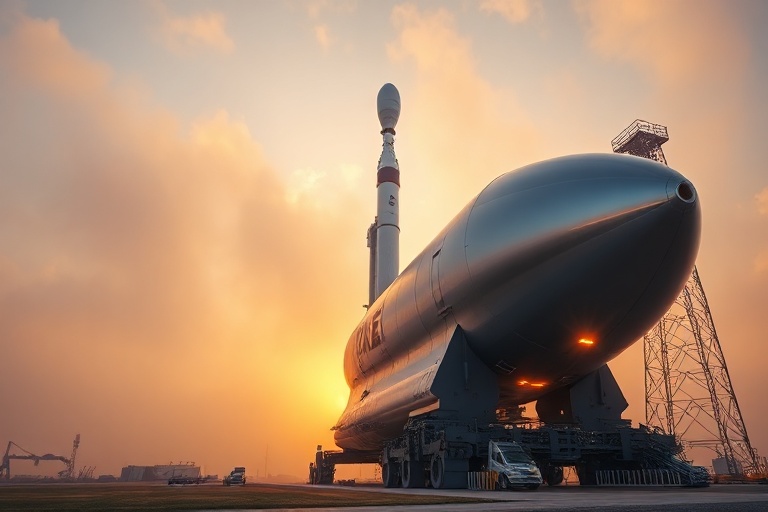
Elon Musk’s SpaceX has long been at the forefront of space exploration, but its Starship program represents a quantum leap forward. More than just another rocket, Starship is a fully reusable, super-heavy lift vehicle designed to carry both crew and cargo to Earth orbit, the Moon, and eventually Mars. Its development is not merely an engineering challenge—it’s a potential turning point for humanity’s future among the stars.
The Starship system consists of two main components: the Starship spacecraft itself and the Super Heavy booster. Together, they form a fully reusable transportation system capable of lifting over 100 metric tons to Earth orbit. This capacity dwarfs that of traditional rockets, promising to slash the cost of space travel by orders of magnitude. If successful, Starship could make space tourism, lunar bases, and even interplanetary colonization economically viable.
The Evolution of Starship: From Blueprint to Launchpad
SpaceX’s journey with Starship began in earnest in 2017, when Musk first unveiled the design under the name “BFR” (Big Falcon Rocket). The concept was ambitious: a massive, fully reusable rocket that could carry 100 passengers to Mars. Over the years, the design evolved, and by 2019, the name “Starship” became the official moniker for the upper stage, with “Super Heavy” designated for the booster.
The development process has been iterative and, at times, explosive. Early prototypes, such as Starhopper, conducted short “hop” tests to demonstrate basic flight capabilities. Subsequent iterations, like SN8 through SN15, pushed the boundaries further, achieving high-altitude flights and, in some cases, dramatic landings. Each test provided critical data, refining the design and improving reliability.
Despite setbacks—including several spectacular explosions during early test flights—SpaceX’s approach has been one of rapid prototyping and learning from failure. This philosophy has accelerated development, bringing Starship closer to operational status than any previous Mars-capable vehicle.
Key Milestones in Starship’s Development
- 2019: First “hop” test with Starhopper, reaching 150 meters.
- 2020-2021: Multiple prototype flights (SN5, SN6, SN8-SN15) testing high-altitude flights and landings.
- May 2021: Successful first flight of a full-scale prototype (SN15) to 10 km and soft landing.
- 2022: Orbital test flight attempt with Ship 20 and Booster 4, though it ended in an explosion.
- 2023: Continued testing with improved prototypes, focusing on reusability and reliability.
Why Starship Matters: Beyond the Rocket
Starship’s significance extends far beyond its technical specifications. It represents a fundamental shift in how we approach space travel—one that prioritizes cost reduction, reusability, and scalability. Traditional rockets, like NASA’s Space Launch System or Europe’s Ariane 6, are expendable, meaning each launch discards millions of dollars in hardware. Starship, by contrast, is designed to be fully reusable, with both the booster and spacecraft capable of being flown multiple times.
This reusability could drive the cost of space travel down to as little as $10 per kilogram to orbit—a fraction of the current cost. Such a reduction would unlock new possibilities, from large-scale satellite deployments to commercial space stations and even lunar tourism. NASA has already taken notice, selecting Starship as the lunar lander for its Artemis program, which aims to return humans to the Moon by 2026.
But Starship’s ambitions don’t stop at the Moon. Musk has long stated that the ultimate goal is to establish a self-sustaining city on Mars. Starship is the vehicle that could make that dream a reality. By enabling affordable, frequent missions to the Red Planet, it could pave the way for humanity to become a multi-planetary species—a goal Musk has called “the most important thing we can do in our lifetime.”
The Broader Implications: A New Era for Space Exploration
The ripple effects of Starship’s success could reshape industries, economies, and even geopolitics. For the commercial sector, Starship could democratize access to space, allowing startups and research institutions to launch missions that were previously unaffordable. Companies like SpaceX, Blue Origin, and others are racing to develop next-generation rockets, but Starship’s scale and reusability give it a competitive edge.
On a global scale, Starship could shift the balance of spacefaring power. The U.S. has long dominated space exploration, but China, India, and private companies in Europe and elsewhere are investing heavily in their own programs. Starship’s success could solidify America’s lead, particularly in the emerging market for lunar and Martian infrastructure.
There are challenges, of course. Regulatory hurdles, environmental concerns, and the sheer complexity of interplanetary travel remain formidable obstacles. SpaceX has faced criticism for its rapid development pace and the risks associated with its testing methods. Yet, if Starship proves reliable, it could become the backbone of a new space economy—one where Earth’s orbit is a bustling highway, the Moon is a waypoint, and Mars is a destination.
Starship’s Potential Impact on Key Sectors
- Commercial Spaceflight: Lower costs could enable new business models, from space tourism to in-orbit manufacturing.
- Lunar Exploration: NASA’s Artemis program relies on Starship for crewed landings, potentially accelerating human return to the Moon.
- Mars Colonization: Starship’s payload capacity and reusability make it the leading candidate for early Mars missions.
- Science and Research: Space telescopes, planetary probes, and deep-space missions could become more frequent and affordable.
- Geopolitical Influence: Dominance in heavy-lift launch capabilities could shape international alliances and space policy.
What’s Next for Starship?
As of 2024, Starship is inching closer to its first orbital test flight—a critical milestone that will demonstrate its full capabilities. SpaceX has conducted multiple static fire tests and is preparing for an ambitious launch from Starbase in Boca Chica, Texas. If successful, this flight will validate the rocket’s design and set the stage for crewed missions and lunar landings.
But the road ahead is not without risks. SpaceX must prove that Starship can be safely and reliably operated, both for uncrewed cargo missions and, eventually, crewed flights. The company will also need to address regulatory concerns, particularly around environmental impact and safety protocols. NASA, meanwhile, is closely monitoring progress, as its Artemis timeline depends on Starship’s readiness.
For space enthusiasts, the coming years promise to be an exhilarating ride. Starship’s success could mark the beginning of a new chapter in human history—one where the boundaries of Earth are no longer the limits of our ambition. Whether it’s ferrying tourists to a lunar hotel or laying the groundwork for a Martian colony, Starship is more than a rocket. It’s a symbol of what’s possible when innovation meets determination.
As Musk himself has said, “The future of humanity is fundamentally a multi-planet species.” Starship may well be the vehicle that gets us there.
For those eager to follow Starship’s progress, SpaceX’s official updates and NASA’s Artemis program are the best sources of information. The next giant leap for mankind could be just over the horizon.
Explore more about space technology and innovation on Dave’s Locker.