Starship’s Second Flight: What the Latest Test Means for Space Travel
“`html
Starship’s Second Flight: What Went Right and What Comes Next
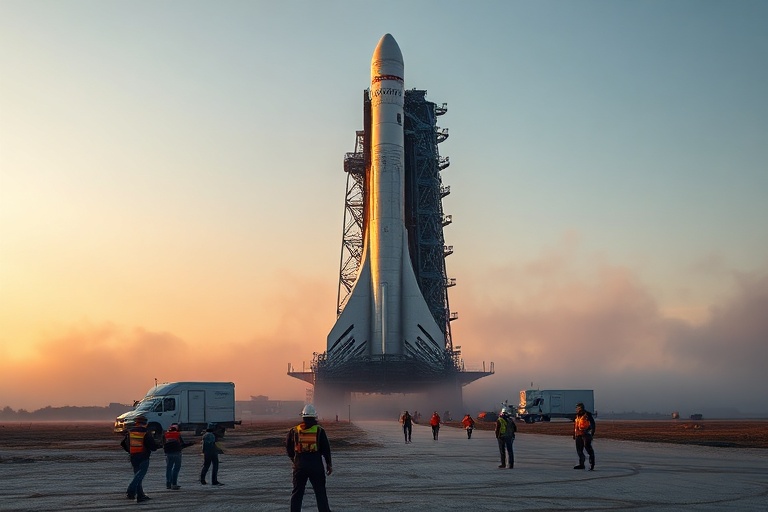
SpaceX’s Starship rocket completed its second integrated flight test on November 18, 2023, lifting off from Boca Chica, Texas, and traveling farther and higher than its April attempt. While the mission ended with both the Super Heavy booster and the Starship upper stage lost, the test delivered critical data that could reshape the future of space travel. The flight lasted just over eight minutes, achieving key milestones such as stage separation and engine cutoff before the vehicle’s rapid unscheduled disassembly.
The launch was not just a technical milestone—it was a statement. With NASA’s Artemis program relying on Starship to land astronauts on the Moon and private companies eyeing orbital refueling, reliability and safety have never been more urgent. This test, despite its fiery conclusion, provided engineers with the telemetry needed to refine the vehicle’s design and operational procedures.
Breaking Down the Flight: Key Moments and Data
Starship’s journey began with all 33 Raptor engines on the Super Heavy booster igniting simultaneously. Unlike the first flight, which suffered multiple engine failures and structural damage, this attempt showed improved performance during ascent. The hot-staging sequence—where the upper stage’s engines ignite before separation—appeared to go smoothly, a critical innovation to reduce mass and increase payload capacity.
Key flight events included:
- Max Q (maximum aerodynamic pressure): The rocket endured peak stress at approximately T+1 minute, testing its structural integrity.
- Stage separation: Occurred at T+2 minutes and 41 seconds, with Starship’s six Raptor engines igniting while still attached to the booster.
- Supersonic flight and engine cutoff: Starship continued to accelerate, reaching an altitude of roughly 148 kilometers—officially entering space—before its flight termination system activated.
- Loss of vehicles: Both stages were destroyed during descent, though SpaceX emphasized that the data collected outweighed the hardware cost.
Elon Musk noted in a post-flight briefing that the primary objectives were to gather aerodynamic data and test stage separation, both of which were largely successful. The company stressed that rapid iteration is part of its development philosophy, a model borrowed from software engineering and applied to rocket science.
A Test Flight with Global Implications
Starship is more than a rocket—it represents a potential shift in how humanity accesses space. Unlike traditional expendable launch systems, Starship is fully reusable, designed to carry up to 100 metric tons to low Earth orbit and beyond. This capability could dramatically reduce the cost of space travel, enabling ambitious projects like Mars colonization, orbital manufacturing, and even point-to-point Earth travel.
NASA’s role in Starship’s development adds weight to the program. Under the $2.9 billion Human Landing System contract, SpaceX is tasked with delivering a lunar lander for the Artemis III mission, currently slated for 2026. The success of this flight test reassured NASA officials, though concerns remain about schedule delays and technical hurdles.
Beyond government contracts, private industry is watching closely. Companies like Relativity Space and Blue Origin are developing heavy-lift vehicles, but none match Starship’s scale or reusability. If SpaceX can achieve regular, reliable flights, it could monopolize the market for large payloads and interplanetary missions.
Critics, however, point to the environmental impact of frequent launches. Starship’s methane-fueled Raptor engines produce carbon emissions, and the sheer scale of fuel consumption—thousands of tons of methane and liquid oxygen per launch—raises concerns about sustainability. SpaceX has not yet addressed these issues publicly, though future environmental assessments may be required as launch cadence increases.
What’s Next for Starship?
SpaceX has already outlined a series of modifications based on the November test. Engineers are analyzing the performance of the heat shield tiles, which protect Starship during re-entry, and the structural integrity of the stainless steel body. The flight termination system, which triggered prematurely in this test, will also undergo review to prevent future unintended activations.
Among the planned improvements:
- Enhanced stage separation: Adjustments to the hot-staging ring and engine timing to reduce shock loads.
- Reinforced heat shield: Upgraded thermal protection to withstand higher re-entry temperatures.
- More robust flight termination: A system designed to activate only after confirming loss of control.
- Regulatory and environmental reviews: Coordination with the FAA to address safety and environmental concerns ahead of future launches.
SpaceX aims to conduct a third flight test within six months, a timeline that would require rapid turnaround and regulatory approval. The company’s iterative approach—learning from each failure—has defined its culture, but it also invites scrutiny from skeptics who question whether such risks are justified in a high-stakes industry.
The broader space community remains cautiously optimistic. While Starship is not yet operational, its progress signals a new era of accessibility in spaceflight. Governments, corporations, and researchers are all waiting to see whether this behemoth can deliver on its promise: making life multiplanetary.
Conclusion: A Small Step Toward a Cosmic Future
The second Starship flight test was neither a total success nor a complete failure—it was a data-rich experiment that moved the needle forward. SpaceX’s willingness to embrace risk and learn from setbacks sets it apart in an industry where caution often trumps ambition. Yet the stakes are higher than ever. With billions of dollars in contracts and the future of human spaceflight on the line, the pressure to deliver is immense.
As SpaceX refines its design and prepares for the next launch, the world watches. Starship is more than a rocket. It is a symbol of what’s possible when innovation meets audacity. And whether it ultimately succeeds or stumbles, its journey will shape the next chapter of space exploration.
For those eager to follow the latest developments, visit our Technology and Science sections for ongoing coverage of Starship and other breakthroughs in aerospace.